What is a cell?
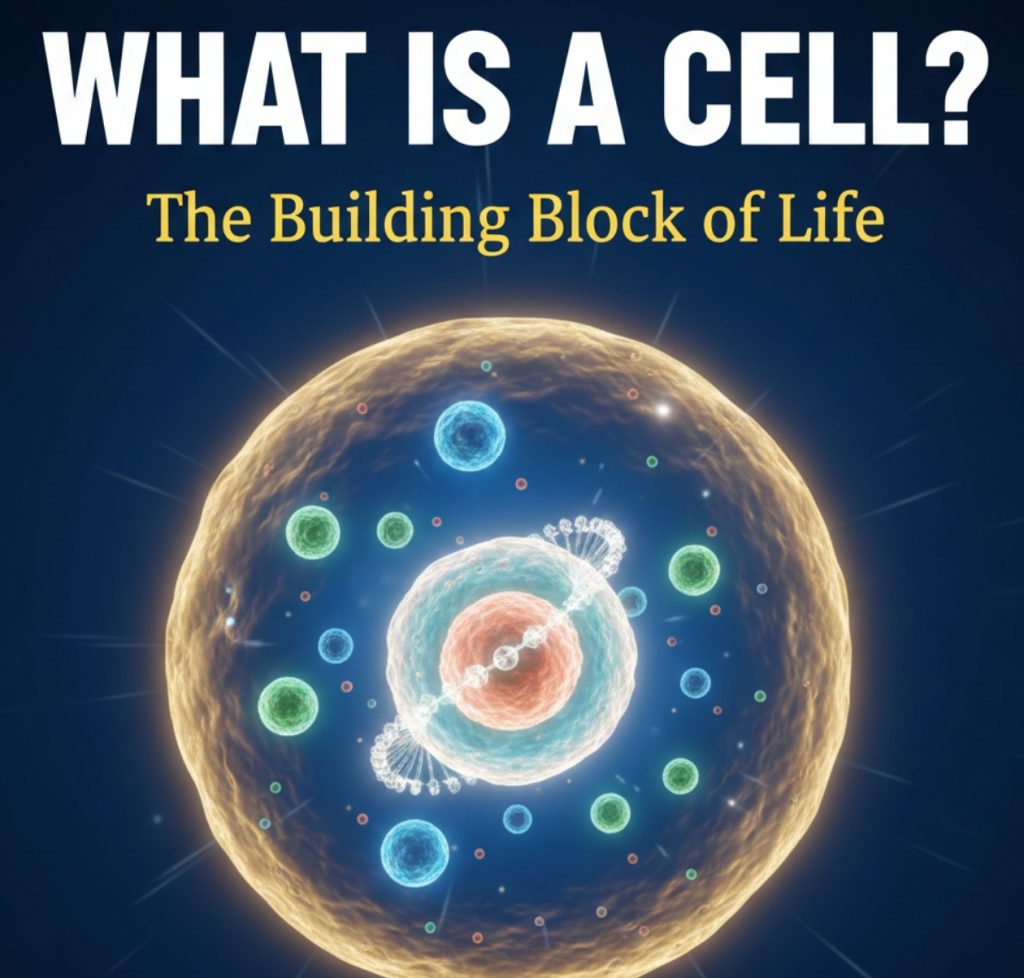
A cell is the smallest living unit that can carry out all life’s basic functions — think of it as the tiny factory that makes you, you. Every cell can take in nutrients, produce energy, copy its DNA, respond to the environment, and (usually) reproduce. Organisms can be single-celled (bacteria, yeast) or multicellular (you, me, trees), but the cell is the universal building block of life.
1. Human body cell — a quick snapshot
Human cells are eukaryotic — they have a true nucleus that holds DNA and a bunch of membrane-bound organelles that do specialized jobs. Most human cells are microscopic (10–30 micrometers across), but they’re unbelievably variable: neurons can be meters long when you stretch their axons, fat cells can balloon up to 100 micrometers, and red blood cells are small, flexible discs optimized for oxygen delivery.
2. Types of cell (super high-level categories)
- Epithelial cells — line surfaces (skin, gut). Barrier + absorption + secretion.
- Muscle cells (myocytes) — contract for movement and force.
- Nerve cells (neurons) — transmit electrical signals and process information.
- Connective tissue cells (fibroblasts, adipocytes) — structural support and energy storage.
- Blood cells — red blood cells (carry O₂), white blood cells (immune defense), platelets (clotting).
- Stem cells — undifferentiated cells that can become other cell types.
- Germ cells — sperm and eggs (carry genetic material to next generation).
(There are hundreds of specialized subtypes across those buckets — the human body is cellular diversity chaos in the best way.)
3. How many cells are in the human body?
Short answer: a LOT — on the order of tens of trillions.
A widely-cited estimate puts it at roughly 30–40 trillion human cells (one commonly quoted figure is ~37 trillion). That’s an estimate because it depends on how you count (which cell types, body size, etc.).
Fun contrast: the microbes in and on your body (your microbiome) were once estimated to be of a similar magnitude, which led to the “we’re more bacterial than human” soundbite — those numbers have been revised, but the takeaway is the same: your body is an ecosystem, not just human cells.
4. What’s inside a cell? (organelles & their vibe)
Think of a cell like a compact city with specialized factories and transport systems.
- Plasma membrane — city wall + customs: controls what enters/leaves (lipid bilayer + proteins).
- Nucleus — City Hall: stores DNA (organized as chromosomes) and controls gene expression.
- Nucleolus — a busy workshop inside City Hall where ribosomes are made.
- Mitochondria — power plants: generate ATP (the cell’s energy currency) via respiration.
- Ribosomes — protein printers: read RNA and build proteins (floating or on rough ER).
- Endoplasmic reticulum (ER)
- Rough ER — studded with ribosomes; manufactures proteins for export or membrane insertion.
- Smooth ER — lipid production, detox, calcium storage.
- Golgi apparatus — post office: modifies, sorts, ships proteins and lipids.
- Lysosomes — recycling centers: break down waste and worn-out parts (digestive enzymes).
- Peroxisomes — detox units: break down fatty acids and reactive molecules.
- Cytoskeleton — roads and scaffolding (microtubules, actin filaments, intermediate filaments): shape, transport, and mechanical strength.
- Cytosol — the aqueous “air” of the city where reactions happen.
- Centrioles / centrosome (in most animal cells) — organizers for cell division.
- Vacuole — big storage space (especially huge in plant cells).
- Chloroplasts — solar panels (in plant cells): do photosynthesis.
5. Cell breakdown — structure, lifecycle, and endings
Structural breakdown (how a cell is organized)
Cells are organized into compartments (organelles) mostly via membranes — this separation lets different chemical environments exist at once (like an acid-filled lysosome next to neutral cytosol).
The cell cycle — how cells reproduce
- Interphase — cell grows, duplicates DNA (G1 → S → G2).
- Mitosis — nucleus divides (prophase → metaphase → anaphase → telophase).
- Cytokinesis — cytoplasm divides, making two daughter cells. For gametes: meiosis — two rounds of division to make haploid sperm/eggs (genetic shuffling included).
How cells die (controlled vs chaotic)
- Apoptosis — programmed cell death (neat, tidy, signals to immune system). Important for development and removing damaged cells.
- Necrosis — traumatic cell death (inflammation follows).
- Autophagy — “self-eating” recycling process cells use to survive starvation or remove damaged parts.
- Senescence — aging cells that stop dividing but don’t die; sometimes harmful if they accumulate.
6. How cells communicate and cooperate
Cells talk via chemical signals (hormones, neurotransmitters), direct contact (gap junctions), and surface receptors. Body-level functions — like digestion, movement, and thought — emerge from massive coordination among trillions of individual cells.
7. How we study cells (mini lab tour)
- Light microscopy — basic shapes and stained structures.
- Fluorescence microscopy — tag proteins with fluorescent markers to see specific parts.
- Electron microscopy — ultra-high resolution for organelles and membranes.
- Flow cytometry — count and sort cell types by markers.
- Sequencing & single-cell RNA-seq — measure what genes individual cells are expressing.
- Cell culture — grow cells in dishes to experiment on them.
8. Quick FAQs & myth-busting
- Are cells alive on their own? Single cells can be independent (bacteria, yeast). Multicellular cells usually rely on the organism and specialize.
- Do all cells have DNA? Eukaryotic cells do in a nucleus; mature red blood cells in humans lose their nucleus and DNA to make more room for oxygen.
- Can cells repair themselves? Yes — many have repair systems; severe damage triggers apoptosis or immune cleanup.
9. Fun tiny facts (because biology is weird and cool)
- Your skin replaces itself every few weeks — cells are constantly being born and dying.
- Some neurons you’re born with last your whole life.
- Cells can migrate — immune cells chase pathogens like tiny Pac-Men.
Closing — why cells matter
Cells are the place where chemistry becomes life. Understanding them explains health, disease, growth, aging, and why your muscles get sore after workouts. Whether you want to code an app, build a gym routine, or start a biotech startup someday, knowing how cells work gives you a major edge.