Transformers are essential devices in electrical and electronic systems. They make it possible to change voltage levels safely, enabling electricity to travel efficiently from power plants to our homes and devices.
What is a Transformer?
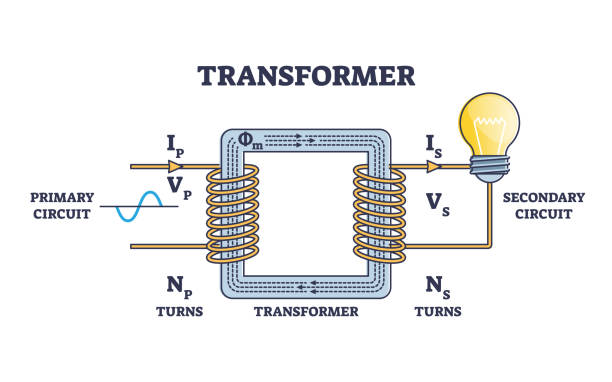
A transformer is an electrical device that transfers electrical energy between two or more circuits through electromagnetic induction. It can increase (step-up) or decrease (step-down) voltage while keeping the frequency constant.
Key Idea: Transformers do not generate power; they only convert voltage levels.
How Does a Transformer Work?
Transformers work based on Faraday’s Law of Electromagnetic Induction:
Primary Coil: Connected to the input voltage source. When AC current flows, it creates a magnetic field.
Magnetic Core: The magnetic field passes through a core (usually laminated iron), linking the primary coil to the secondary coil.
Secondary Coil: The changing magnetic field induces a voltage in the secondary coil.
Step-Up Transformer: Secondary voltage is higher than primary voltage.
Step-Down Transformer: Secondary voltage is lower than primary voltage.
The voltage ratio depends on the number of turns in the primary vs. secondary coils:
V₂ / V₁ = N₂ / N₁
Where V = voltage, N = number of turns.
Types of Transformers
1. Based on Function
Step-Up Transformer: Increases voltage for long-distance power transmission.
Step-Down Transformer: Reduces voltage for household appliances and electronics.
Isolation Transformer: Separates two circuits for safety without changing voltage.
Autotransformer: Shares part of the winding for compact, efficient design.
2. Based on Core Material
Iron-Core Transformer: Common in power supply systems.
Air-Core Transformer: Used in high-frequency applications.
Toroidal Transformer: Ring-shaped, efficient, low electromagnetic interference (EMI).
3. Based on Phase
Single-Phase Transformer: Used in homes and small electronics.
Three-Phase Transformer: Used in industrial and power transmission systems.
Applications of Transformers
Electricity Distribution: Step-up at power plants, step-down near homes.
Electronics: Power adapters for phones, laptops, and TVs.
Industrial Machines: Voltage regulation for motors and machinery.
Audio Systems: Impedance matching for amplifiers.
Renewable Energy: Solar and wind systems to adjust voltage.
Advantages
Efficient Voltage Conversion: Minimizes energy loss in transmission.
Safety: Step-down transformers reduce high voltage to usable levels.
Versatility: Can be designed for a wide range of voltages and currents.
Reliability: Simple design with low maintenance.
Fun Facts
Transformers only work with AC (Alternating Current), not DC.
Nikola Tesla invented the first modern transformer in the 1880s.
Toroidal transformers are often used in high-end audio equipment because they reduce hum and noise.
Final Thoughts
Transformers are the unsung heroes of electrical power. They ensure electricity travels efficiently from power plants to your home while providing the correct voltage for devices. From phone chargers to industrial power systems, transformers make our modern electric world possible.