
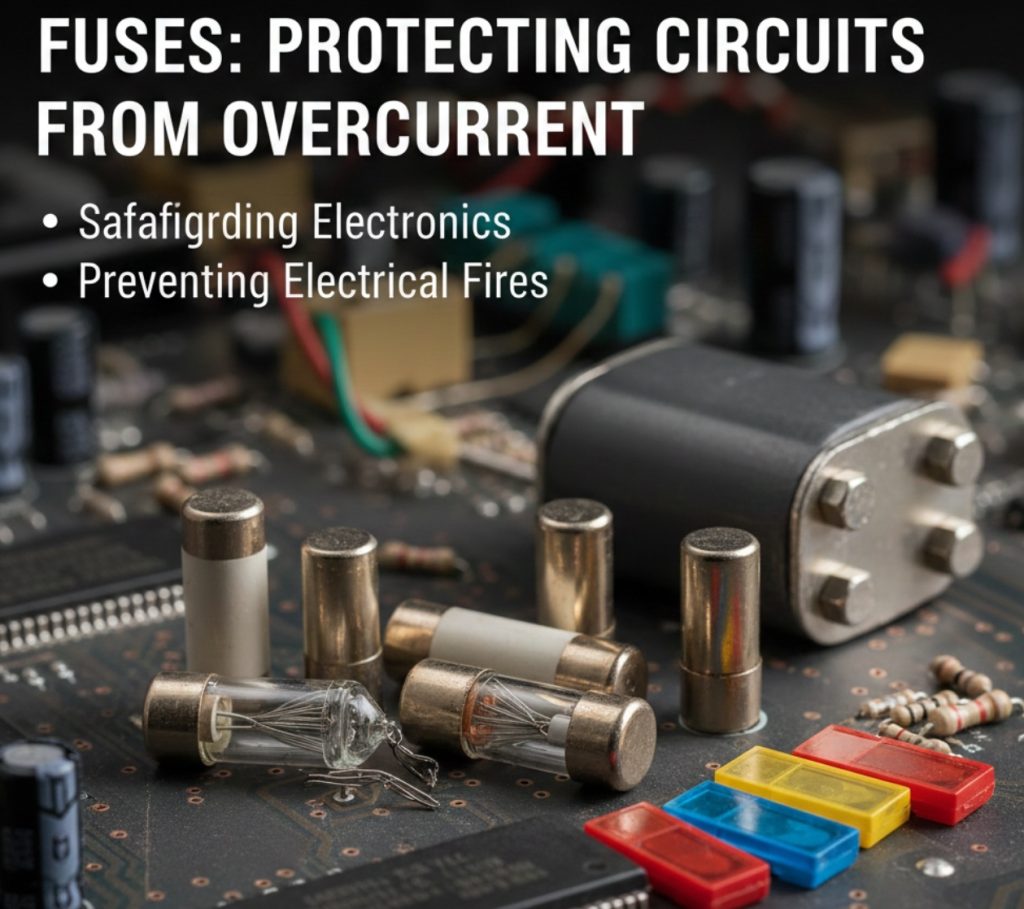
A fuse is a safety device in electrical and electronic circuits that prevents damage caused by excessive current. It acts as a sacrificial device, breaking the circuit when current exceeds safe levels.
What is a Fuse?
A fuse is made of a thin metal wire or strip enclosed in a non-conductive casing. When the current exceeds the rated value:
- The metal wire melts or blows
- The circuit is opened, stopping the flow of electricity
- Prevents damage to components or even fires
Think of a fuse as an electronic “guardian” that sacrifices itself to protect the rest of the circuit.
How a Fuse Works
- Current flows through the fuse under normal conditions.
- If a surge or short circuit occurs, the current exceeds the fuse rating.
- The metal filament melts due to excessive heat.
- The circuit is interrupted, stopping the flow of electricity.
Fuses are one-time use devices; once blown, they need to be replaced.
Types of Fuses
1. Based on Construction
- Cartridge Fuse: Cylindrical, enclosed in a tube; common in appliances and automotive circuits.
- Blade Fuse / Automotive Fuse: Plastic casing with metal prongs; used in cars.
- Glass Fuse: Transparent casing; easy to see if blown.
- Ceramic Fuse: Can handle higher current and voltage; used in industrial applications.
2. Based on Response Time
- Fast-Blow Fuse: Responds immediately to overcurrent; protects sensitive electronics.
- Slow-Blow Fuse: Tolerates short surges; used in motors and devices with inrush currents.
Applications of Fuses
- Household Appliances: Protect against overload and short circuits.
- Automobiles: Protect circuits in cars and motorcycles.
- Industrial Equipment: Prevent damage in heavy machinery and transformers.
- Electronics: Safeguard sensitive components like motherboards, power supplies, and amplifiers.
Key Features
- Rating: Fuses are rated by current (A) and voltage (V).
- One-time use: Must be replaced after blowing.
- Safety: Prevents fire hazards and component damage.
- Simple and Reliable: Low-cost, easy to install.
Fun Facts
- Fuses were invented in the 19th century to protect telegraph lines.
- Fast-blow fuses are used in smartphones and small electronics for precise protection.
- Slow-blow fuses are used in microwave ovens and motors, where startup currents are high.
Quick Reference
| Type | Feature | Common Use Case |
|---|---|---|
| Cartridge Fuse | Cylindrical, enclosed | Appliances, industrial |
| Blade / Auto Fuse | Plastic with metal prongs | Cars, motorcycles |
| Glass Fuse | Transparent, visible | Electronics, small devices |
| Ceramic Fuse | High voltage & current | Industrial equipment |
| Fast-Blow | Immediate response | Sensitive electronics |
| Slow-Blow | Tolerates surges | Motors, appliances |