
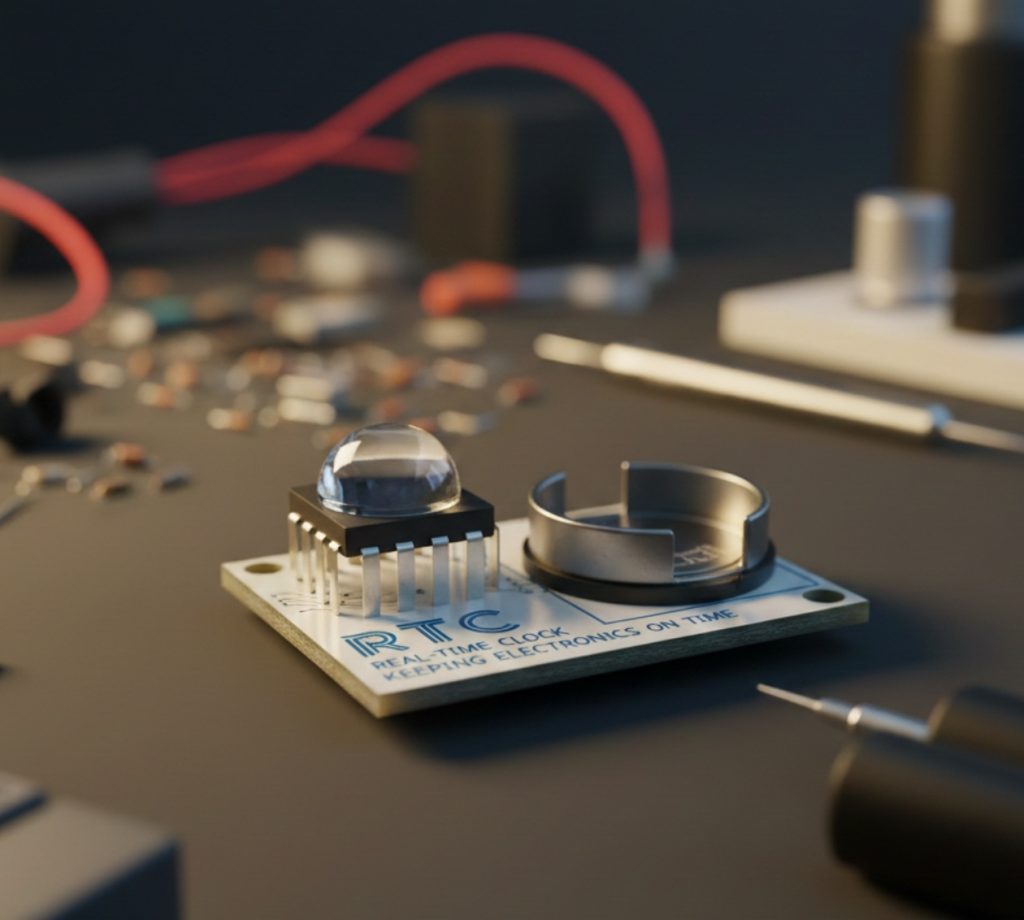
A Real-Time Clock (RTC) is an electronic component or module that keeps track of the current time and date, even when the main device is powered off. RTCs are essential in computers, embedded systems, and IoT devices where accurate timing is crucial.
What is an RTC?
- An RTC is basically a clock in a chip.
- It keeps seconds, minutes, hours, day, month, and year.
- Powered by a small battery (usually a coin cell), allowing it to continue working when the main system is off.
- Ensures timekeeping continuity in systems without relying on the main processor.
How an RTC Works
- Oscillator: RTC uses a 32.768 kHz crystal oscillator to generate a precise clock signal.
- Counter: Divides the oscillator frequency to keep track of seconds, minutes, hours, and date.
- Battery Backup: A small battery keeps the RTC running when the main power is off.
- Interface: Communicates with microcontrollers or processors via I2C, SPI, or parallel interfaces.
Essentially, an RTC is like a tiny, precise clock chip inside your electronics.
Types of RTCs
1. Standalone RTC
- Independent IC module with its own battery and oscillator.
- Common examples: DS1307, DS3231.
2. Embedded RTC
- Built into microcontrollers or SoCs.
- Saves space, but may require external battery for backup.
3. Network RTC / NTP-Synced
- Synchronizes time over the internet (Network Time Protocol).
- Used in IoT devices and networked systems for precise timing.
Applications of RTC
- Computers & Laptops: Maintain system time when powered off.
- Embedded Systems: Time-stamping events in IoT devices, sensors, and data loggers.
- Alarm Clocks & Timers: Standalone or integrated devices.
- Industrial Systems: Scheduling and automation tasks accurately.
- Consumer Electronics: Cameras, DVRs, and smart devices.
Key Features
- Battery Backup: Keeps time even when main power is off.
- Precision: High accuracy using crystal oscillators.
- Low Power: Consumes very little energy, ideal for battery-operated devices.
- Interface Options: Communicates with MCU via I2C, SPI, or parallel ports.
Fun Facts
- A DS3231 RTC can maintain time within ±2 minutes per year without needing calibration.
- RTCs are critical in data logging systems for timestamping events correctly.
- Even your smartphones use an RTC to maintain time when fully powered down.
Quick Reference
| Feature | Details |
|---|---|
| Core Component | 32.768 kHz crystal oscillator |
| Backup Power | Coin cell battery |
| Interface | I2C, SPI, Parallel |
| Accuracy | ±1–2 minutes/year (depends on IC) |
| Applications | Computers, embedded systems, IoT, alarms |