
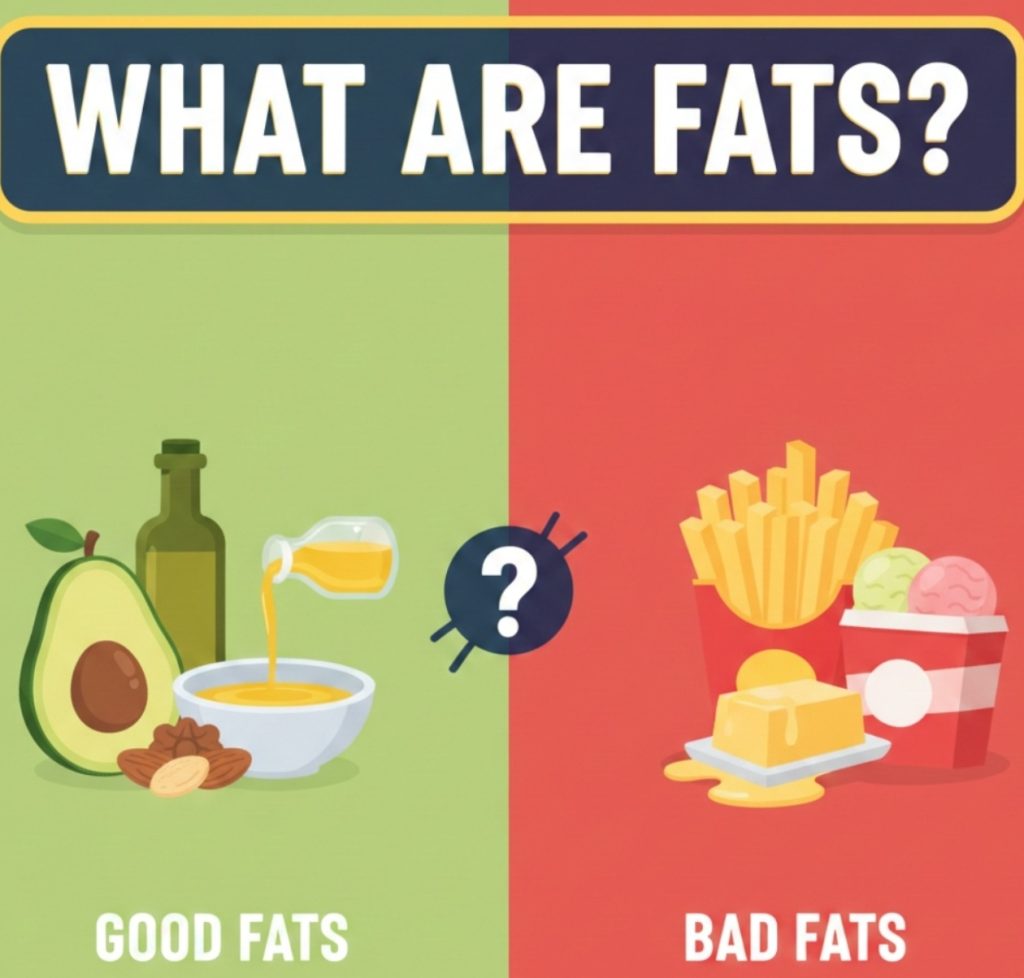
Fats: The Energy-Dense Essential Nutrient
Fats often get a bad rap, but they’re not the enemy. In fact, your body needs fat to survive, stay healthy, and even perform well in workouts. Fats are your long-lasting energy fuel, hormone builders, and nutrient transporters all rolled into one.
What Are Fats?
Fats, also called lipids, are molecules made up of fatty acids. There are different types of fats, some better for you than others:
- Saturated Fats – Usually solid at room temp.
- Examples: butter, ghee, cheese, coconut oil
- Should be eaten in moderation.
- Unsaturated Fats – Usually liquid at room temp and heart-healthy.
- Monounsaturated: olive oil, avocado, nuts
- Polyunsaturated: fish, flaxseeds, walnuts (includes omega-3 & omega-6)
- Trans Fats – Artificial fats found in some fried or processed foods.
- Examples: margarine, packaged snacks
- Avoid as much as possible.
Why Fats Matter
- Energy storage: Fats are calorie-dense, providing 9 kcal per gram, more than double carbs or protein. Great for long-term energy.
- Hormone production: Fats are needed to make testosterone, estrogen, and other hormones.
- Vitamin absorption: Fat-soluble vitamins (A, D, E, K) require fat to be absorbed.
- Brain health: Your brain is ~60% fat — healthy fats help memory, mood, and cognition.
- Cell structure: Every cell membrane in your body is made of fat.
How Much Fat Do You Need?
Fat intake depends on total calories, but general guidelines:
- 20–35% of daily calories from fat
- Focus on unsaturated fats for heart and brain health
- Limit saturated fats, avoid trans fats
(Example: If you eat 2,000 kcal/day, 400–700 kcal should come from fat — that’s about 44–78 g of fat.)
Good Fat Sources
- Healthy oils: olive oil, avocado oil, flaxseed oil
- Nuts & seeds: almonds, walnuts, chia seeds, pumpkin seeds
- Fatty fish: salmon, mackerel, sardines
- Avocados & olives
Foods to limit: deep-fried foods, packaged snacks, margarine, processed baked goods.
Fun Fat Facts
- Fats have 9 calories per gram — energy-packed but slow-burning.
- Eating fat doesn’t automatically make you fat; excess calories from any source can lead to fat gain.
- Including healthy fats in meals increases satiety, keeping you full longer.
Takeaway
Fats aren’t just for flavor — they’re essential for energy, hormones, brain health, and nutrient absorption. Focus on quality over quantity, prioritize unsaturated fats, and don’t fear the fat. Your body actually loves it.