Agnosticism gets tossed around like it’s vague fence-sitting. But it’s actually a specific position about knowledge, not just moodiness about religion. If you want the short version: agnosticism says “I don’t (or can’t) know.” Simple — but the implications are interesting.
What is agnosticism?
Agnosticism is the view that the existence (or nonexistence) of gods or the divine is unknown or unknowable. It’s about epistemology — how we know stuff — not directly about whether someone believes in a god.
Etymology check (quick & nerdy): the word literally means “without knowledge” — from the prefix a- (without) + gnosis (knowledge).
The two axes: belief vs. knowledge
A good way to think about it is a 2×2 grid:
- Theism / Atheism — answers the belief question (do you believe a god exists?).
- Gnosticism / Agnosticism — answers the knowledge question (do you claim to know?).
So someone can be:
- Gnostic theist: believes and claims knowledge.
- Agnostic theist: believes but admits they don’t know for sure.
- Gnostic atheist: doesn’t believe and claims to know there’s no god.
- Agnostic atheist: doesn’t believe but doesn’t claim certain knowledge.
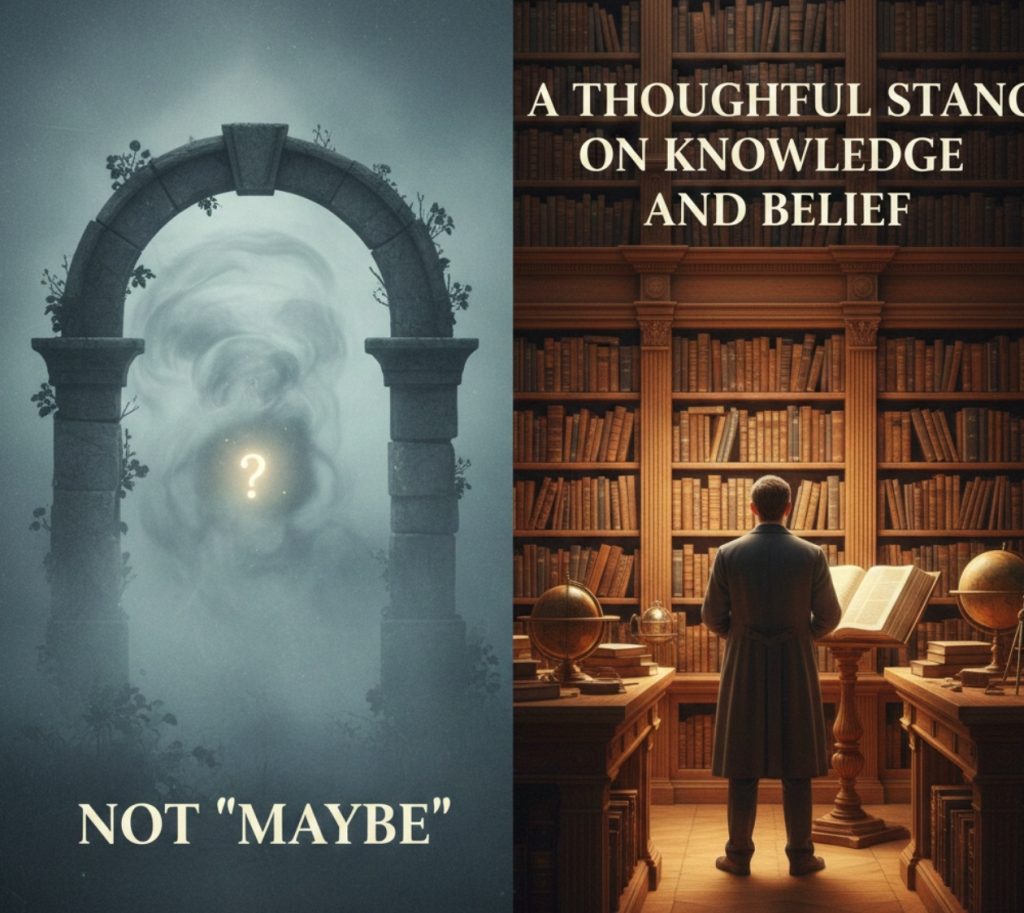
This clears up the sloppy use of “agnostic” as mere fence-sitting.
Flavors of agnosticism
Agnosticism isn’t one-size-fits-all. Common variants:
- Strong (hard) agnosticism: the view that knowledge of gods is inherently impossible.
- Weak (soft) agnosticism: we don’t know now, but it might be knowable in principle.
- Apathetic agnosticism (ignostic/igtheist vibe): the question isn’t meaningful or worth pursuing — “I don’t care enough to look that deep.”
- Practical agnosticism: lives as if the question doesn’t change daily life, regardless of theoretical positions.
Why people become agnostic
There are lots of honest, practical reasons:
- Epistemic humility — recognizing limits in evidence and reasoning.
- Conflicting evidence — religious texts and experiences are ambiguous or contradictory.
- Philosophical caution — “extraordinary claims need extraordinary evidence.”
- Personal experience — doubts, unanswered questions, or unresolved trauma with religion.
- Intellectual curiosity — preferring open inquiry over dogma.
Psychological & social side
Agnosticism can shape how someone experiences life:
- Comfort with uncertainty: many agnostics train themselves to sit with unknowns.
- Open-mindedness: often correlated with tolerance for diverse views.
- Identity: being agnostic can be social (part of communities or solitary).
- Ethics without deity: most agnostics derive morals from reason, empathy, social contracts, or secular philosophies.
Important: agnosticism isn’t a morality kit — it doesn’t tell you how to behave, just what you claim to know.
Common misconceptions — busted
- “Agnostics are just wishy-washy.” Nope — many are deliberate and reflective about what counts as knowledge.
- “Agnostic = atheist.” Not necessarily; they answer different questions.
- “Agnostics can’t be spiritual.” False — some agnostics enjoy rituals, awe, and meaning without a named god.
- “Agnosticism is indecision.” Often it’s a principled stance about evidence and limits.
Quick FAQs
Q: Can an agnostic be religious?
A: Yes — an agnostic theist believes but admits they don’t have absolute proof.
Q: Is agnosticism the same as skepticism?
A: They overlap. Skepticism is a method (ask for evidence); agnosticism is a position about knowledge.
Q: Does agnosticism mean “I don’t care”?
A: Sometimes (apathetic agnosticism), but often it means “I care, I’m just cautious.”
Why it matters
Agnosticism models intellectual humility — a useful stance in an era of hot takes and fast certainties. It encourages curiosity, careful evidence-appraisal, and respect for others’ conclusions without pretending to have the final answer.
Final thought
Agnosticism isn’t weak — it’s honest. It’s a reminder that some questions are complicated, and sometimes the smartest move is to admit what you don’t know while still living ethically and meaningfully.