Introduction
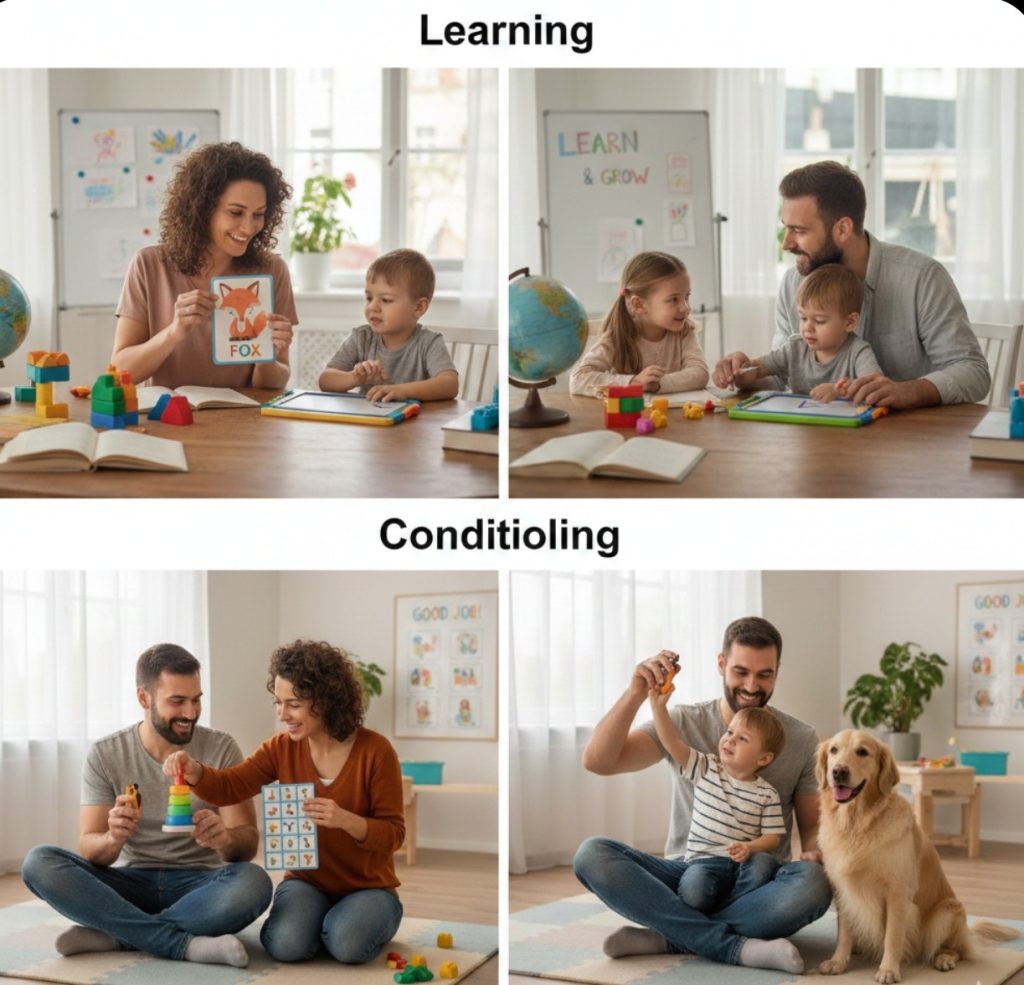
From the moment we are born, we begin learning. Not in classrooms, not from textbooks, but through raw experience — sounds, touches, rewards, mistakes, and observations. Long before we can speak, our brains are already busy connecting patterns: this sound means food, this action brings comfort, this place feels unsafe. These processes fall under one of the most important areas of psychology: learning and conditioning.
Learning explains how behavior changes over time due to experience. Conditioning explains how those changes happen — through association, consequences, and observation. Together, they help us understand habits, fears, addictions, motivation, education, parenting, marketing, and even culture itself.
This blog explores learning and conditioning in depth, breaking down major theories, real-life examples, and practical applications — without drowning you in jargon.
What Is Learning in Psychology?
In psychology, learning is defined as a relatively permanent change in behavior, knowledge, or thinking that occurs as a result of experience.
A few important points about this definition:
- Learning is not temporary (mood or fatigue doesn’t count).
- Learning does not require conscious awareness.
- Learning is inferred through behavior or performance.
For example:
- A child learning language
- A person developing a fear after an accident
- A student improving problem-solving skills
- A habit forming after repeated reinforcement
Learning is not just academic — it is biological survival in action.
Conditioning: The Engine of Learning
Conditioning refers to the processes through which learning occurs. Psychologists mainly describe three forms:
- Classical conditioning (learning through association)
- Operant conditioning (learning through consequences)
- Observational learning (learning by watching others)
Each explains a different layer of human behavior.
Classical Conditioning: Learning by Association
The Core Idea
Classical conditioning occurs when a neutral stimulus becomes associated with a meaningful stimulus, producing a learned response.
This form of learning was first systematically studied by Ivan Pavlov, a Russian physiologist.
Pavlov’s Experiment
Pavlov noticed that dogs began salivating not only when food was presented, but also when they heard footsteps of the person bringing food. He designed an experiment:
- Food → Salivation (natural response)
- Bell + Food → Salivation
- Bell alone → Salivation
Over time, the bell became a conditioned stimulus, triggering salivation without food.
Key Components
- Unconditioned stimulus (UCS): Naturally produces a response (food)
- Unconditioned response (UCR): Automatic response (salivation)
- Conditioned stimulus (CS): Previously neutral stimulus (bell)
- Conditioned response (CR): Learned response (salivation)
Real-Life Examples
- Fear of hospitals after painful treatment
- Feeling calm when hearing a specific song
- Anxiety triggered by notification sounds
- Brand logos creating emotional desire
Classical conditioning strongly influences emotions, fears, and preferences — often without conscious control.
Operant Conditioning: Learning by Consequences
The Core Idea
Operant conditioning explains how behaviors are shaped by their consequences. Behaviors followed by positive outcomes are repeated, while those followed by negative outcomes tend to fade.
This theory was developed by B.F. Skinner.
Reinforcement and Punishment
Reinforcement increases behavior:
- Positive reinforcement: Adding a reward (praise, money, food)
- Negative reinforcement: Removing something unpleasant (pain relief, alarm stopping)
Punishment decreases behavior:
- Positive punishment: Adding something unpleasant (scolding, fine)
- Negative punishment: Removing something pleasant (phone taken away)
Schedules of Reinforcement
Not all rewards are equal. The timing matters:
- Fixed ratio: Reward after a set number of actions
- Variable ratio: Reward after unpredictable actions (very addictive)
- Fixed interval: Reward after fixed time
- Variable interval: Reward after unpredictable time
Social media, gambling, and mobile apps heavily rely on variable reinforcement schedules.
Real-Life Examples
- Studying harder after receiving praise
- Using seatbelts to avoid fines
- Exercising because it improves mood
- Avoiding actions that lead to embarrassment
Operant conditioning explains habit formation, discipline systems, motivation, and addiction.
Observational Learning: Learning Without Direct Experience
The Core Idea
Humans can learn simply by observing others — without direct reinforcement or punishment.
This concept was introduced by Albert Bandura.
The Bobo Doll Experiment
Children who watched adults behave aggressively toward a doll were more likely to imitate that behavior later. This proved learning can occur through observation alone.
Why Observational Learning Matters
- Children copy parents
- Students imitate teachers
- Employees follow leaders
- Society absorbs norms from media
Role models strongly influence behavior — for better or worse.
Learning, Conditioning, and Habit Formation
Habits are learned behaviors strengthened through repetition and reinforcement.
A common habit loop:
- Cue (trigger)
- Behavior (routine)
- Reward (reinforcement)
Over time, the brain automates the process, conserving energy. This explains why bad habits are hard to break and good habits require intentional design.
Conditioning and Emotional Learning
Many emotional reactions are learned, not innate.
- Phobias often develop through classical conditioning
- Anxiety can be reinforced through avoidance
- Confidence grows through repeated success
Therapies like exposure therapy and behavioral therapy are built directly on conditioning principles.
Applications in Real Life
Education
- Immediate feedback enhances learning
- Reinforcement improves motivation
- Modeling improves skill acquisition
Parenting
- Consistent reinforcement shapes behavior
- Punishment without explanation creates fear
- Modeling matters more than instruction
Marketing and Media
- Emotional association drives brand loyalty
- Variable rewards increase engagement
- Conditioning influences consumer behavior
Self-Improvement
- Habit tracking reinforces progress
- Small rewards sustain consistency
- Environment shapes behavior
Ethical Considerations
Conditioning is powerful. Used ethically, it teaches, motivates, and heals. Used unethically, it manipulates, exploits, and controls.
Understanding learning mechanisms protects individuals from unconscious influence and promotes intentional behavior change.
Conclusion
Learning and conditioning explain how experience becomes behavior. Through association, consequence, and observation, the brain adapts to the world — sometimes brilliantly, sometimes imperfectly.
When we understand these processes, we gain more than knowledge. We gain control — over habits, emotions, learning, and growth.
The mind is always learning. The real question is: what is it being trained to become?