
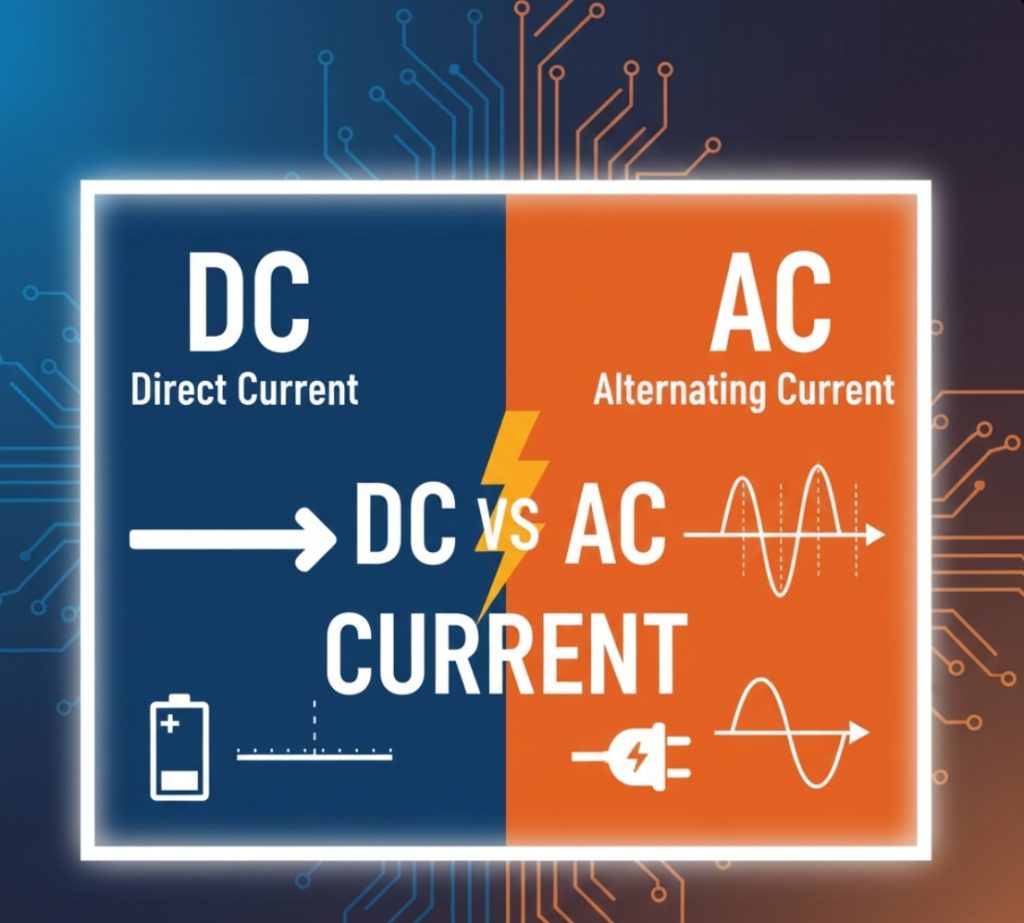
Bet, Bro! Let’s turn DC vs AC into a full readable, scroll-stopping blog that’s detailed, fun, and easy to follow. ⚡
DC vs AC: Understanding the Two Faces of Electricity ⚡🔌
Electricity powers almost everything in your life—from your phone to your fridge—but did you know there are two types of electric current? Meet Direct Current (DC) and Alternating Current (AC). They might sound technical, but they’re actually super easy to understand once you break them down.
1. Direct Current (DC) – The Straight Shooter 🟢
What is it?
Direct Current is electricity that flows in a single direction. The electrons move steadily from the negative end to the positive end, like a calm, one-way river.
Where you see it:
- Batteries (AA, AAA, Li-ion)
- Solar panels
- Laptops, phones, LED lights
Why it’s useful:
- Provides a steady, constant flow of electricity
- Perfect for low-voltage electronics
- Easy to store in batteries
Drawback:
- Doesn’t travel long distances efficiently
- Needs converters for higher voltages
Analogy:
Imagine a highway where all cars move in one direction. Smooth, predictable, and perfect for a straight route—that’s DC.
2. Alternating Current (AC) – The Flip-Flopper 🔄
What is it?
Alternating Current is electricity that changes direction periodically. In most countries, it flips back and forth 50 or 60 times per second (50/60 Hz).
Where you see it:
- Wall outlets at home
- Power grids
- Appliances like TVs, refrigerators, washing machines
Why it’s useful:
- Can be transmitted over long distances efficiently
- Voltage can be increased or decreased easily with transformers
- Ideal for homes, offices, and industries
Drawback:
- Can be tricky for electronics without converters
- Dangerous if mishandled
Analogy:
Picture a two-way street where cars keep reversing direction quickly. That’s AC—always flipping, perfect for delivering power over long distances.
3. DC vs AC: The Quick Comparison
| Feature | DC (Direct Current) | AC (Alternating Current) |
|---|---|---|
| Direction of flow | One-way | Changes periodically |
| Symbol | ⎓ | ~ |
| Sources | Batteries, solar panels | Power plants, wall outlets |
| Transmission | Short distances | Long distances efficiently |
| Common Use | Electronics, storage | Homes, factories, grid power |
| Voltage Control | Hard | Easy with transformers |
4. Fun Facts You’ll Actually Remember 😎
- Edison vs Tesla: DC was Thomas Edison’s weapon, AC was Nikola Tesla’s brainchild. Their “War of Currents” decided how electricity would power the world.
- They work together today: Your phone battery uses DC, but it charges from AC via an adapter.
- AC is super-flexible for homes, DC is super-stable for electronics.
5. Bottom Line
- DC = Straight, steady, battery-friendly 🟢
- AC = Flexible, high-power, long-distance 🔄
Both are essential. Without DC, your phone and gadgets wouldn’t work. Without AC, your house and cities wouldn’t have power. Electricity isn’t just “on or off”—it’s a balance between flow and flexibility.