
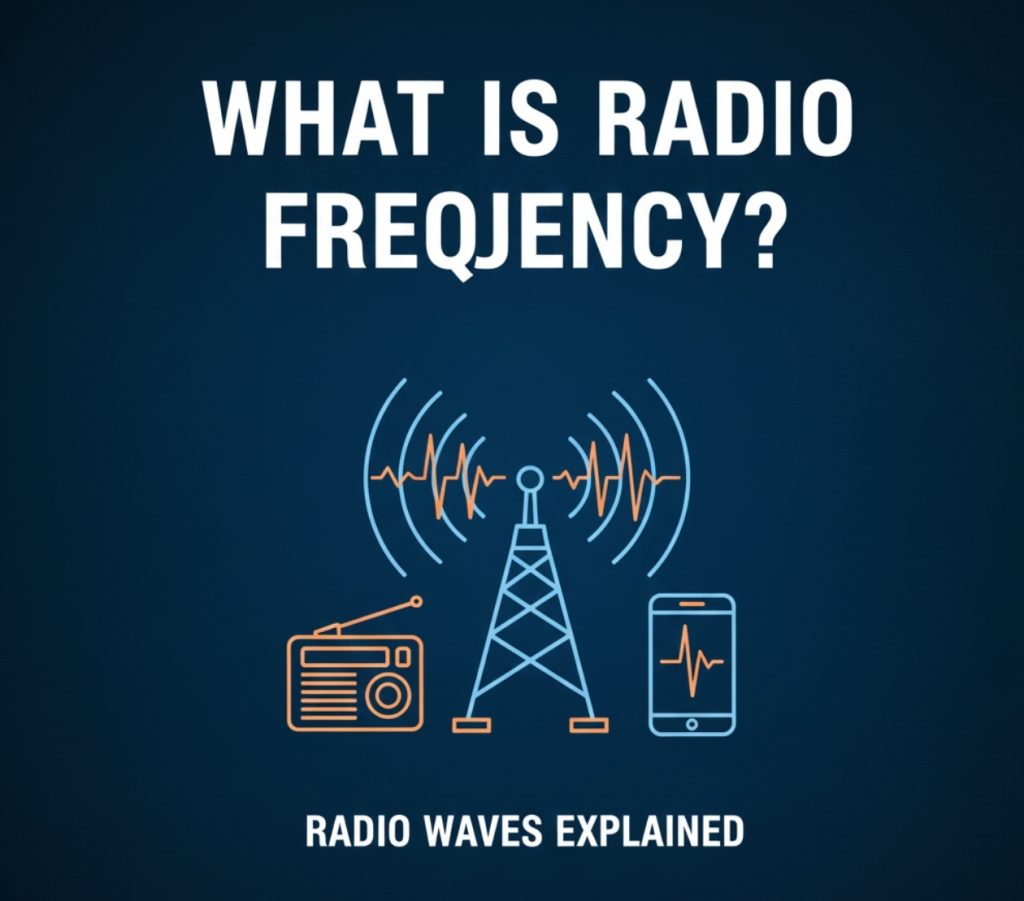
Every smartphone, tablet, or wireless device communicates with the world through RF — Radio Frequency. It’s the invisible highway carrying your voice, video, and data to nearby cell towers and across the globe.
Understanding RF is essential for anyone curious about mobile technology, telecom networks, or wireless communications.
What Is RF (Radio Frequency)?
RF (Radio Frequency) refers to the oscillation rate of electromagnetic waves used for wireless communication.
In simple words:
RF is the electromagnetic signal that your phone uses to talk to cell towers.
- Measured in Hertz (Hz)
- Typical mobile RF bands: kHz, MHz, GHz
- Range of RF: 3 kHz to 300 GHz
How RF Works in Mobile Phones
When you make a call or use mobile internet, your phone performs the following:
- Converts your voice or data into an electrical signal.
- Modulates this signal onto an RF carrier wave.
- Transmits the RF signal through the air to a cell tower.
- The tower receives it and forwards it through the network.
📡 RF is literally the “air highway” for all wireless communication.
RF Spectrum: Understanding Frequency Bands
Mobile networks divide the RF spectrum into frequency bands, each designed for specific applications:
Mobile Network RF Bands
| Generation | Common RF Bands | Usage |
|---|---|---|
| 2G (GSM) | 850, 900, 1800, 1900 MHz | Voice & SMS |
| 3G (UMTS) | 850, 900, 2100 MHz | Mobile internet, video calls |
| 4G (LTE) | 700, 800, 1800, 2100, 2300, 2600 MHz | High-speed internet, streaming |
| 5G | 600–700 MHz (low), 3.3–3.8 GHz (mid), 24–40 GHz (mmWave) | Ultra-fast internet, low latency, IoT |
Why Different RF Bands Are Used
Mobile networks use multiple RF bands because:
- Low-frequency RF (e.g., 700–900 MHz) travels farther and penetrates walls better — ideal for rural areas.
- High-frequency RF (e.g., 3.5 GHz, mmWave) carries more data but has a shorter range — ideal for cities and dense urban areas.
- Multiple bands allow better coverage, higher capacity, and faster data rates.
Modulation: How RF Carries Data
RF waves alone cannot carry your voice or internet data directly. They need modulation, which is the process of encoding information onto the RF carrier.
Common Modulation Techniques:
- Amplitude Modulation (AM)
- Changes the strength of the RF wave
- Used in older radio networks
- Frequency Modulation (FM)
- Changes the frequency of the RF wave
- Used for FM radio and some mobile technologies
- Digital Modulation (modern phones)
- Techniques like QAM, OFDM, PSK
- Used in 3G, 4G, and 5G networks
RF Power and Coverage
The strength of RF signals is measured in watts or dBm.
- Higher RF power → stronger coverage, longer distance
- Too high → interference with other networks, battery drain
Mobile networks carefully manage RF power to balance coverage and efficiency.
RF in 5G: Low, Mid, and High Bands
5G technology is the best example of RF in action:
- Low-Band RF (600–700 MHz)
- Long-range, good indoor penetration
- Moderate speed
- Mid-Band RF (3.3–3.8 GHz)
- Balanced speed & coverage
- Used in urban areas
- High-Band RF / mmWave (24–40 GHz)
- Ultra-fast speed
- Very short-range, poor wall penetration
- Ideal for stadiums, crowded cities
How RF Affects Your Phone Experience
- Signal strength: Higher RF power and better frequency coverage → stronger signal and fewer call drops.
- Data speed: Higher RF frequencies support faster internet.
- Battery life: Weak RF signals make your phone work harder → drains battery faster.
- Network compatibility: Phones must support the RF bands used in your country.
RF Safety
- Mobile RF is non-ionizing, meaning it doesn’t damage DNA like X-rays or gamma rays.
- International guidelines (ICNIRP, FCC) limit RF exposure for safety.
- Long-term exposure at normal phone levels is considered safe.
Summary
RF (Radio Frequency) is the backbone of all wireless communication.
- It is the signal that travels through the air from your phone to towers.
- Different RF bands are used for coverage, speed, and capacity.
- Modern mobile networks (4G, 5G) use multiple RF bands simultaneously.
- Proper RF management ensures strong signal, fast internet, and energy efficiency.
Simply put: RF is the highway that carries your data, voice, and video to the world. 🚀📡