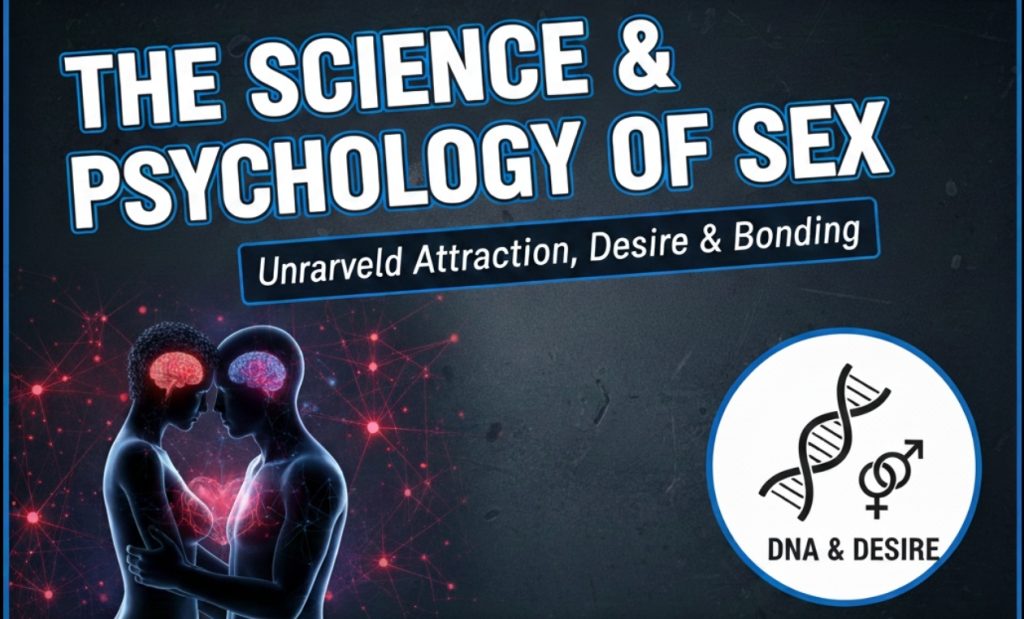
Short answer: your brain’s a chemical rave, evolution is the DJ, and culture writes the playlist.
Sex is biological, emotional, social, and cultural all at once. Below is a single, tidy blog that unpacks the neurochemistry, whether men and women “really enjoy” sex, the evolutionary logic, how attraction works for both sexes, and practical pointers to actually improve sexual well-being. No fluff. Just the good stuff.
Intro — why this matters
People treat sex like either sacred poetry or panic-inducing drama. The truth sits between: sex is a set of evolved systems running on chemicals, context, and stories we tell each other. Knowing how those systems work helps you make smarter choices, feel less confused, and have better, safer sex.
1) What happens in the brain — neurotransmitters and regions
Sex activates several brain systems. Different chemicals handle wanting → doing → rewarding → bonding.
Key brain regions
- Hypothalamus — basic drives (sex, hunger, sleep); controls hormones.
- VTA & nucleus accumbens — the reward circuit; dopamine central.
- Amygdala — flags emotions and salience (is this safe, sexy, or scary?).
- Prefrontal cortex — planning, impulse control, social rules.
- Insula & somatosensory cortex — bodily sensation and awareness.
Major chemicals
- Dopamine — “wanting.” Fuels pursuit and anticipation.
- Oxytocin — “cuddle/attachment.” Rises with touch and orgasm; builds trust.
- Vasopressin — pair-bonding and paternal behaviors in mammals.
- Serotonin — mood regulator; high levels can dampen libido (e.g., SSRIs).
- Norepinephrine — arousal, focus, increased heart rate.
- Endorphins — natural opioids released at orgasm; pleasure + pain relief.
- Testosterone & estrogen — baseline drivers of libido and responsiveness.
Phases (quick)
- Desire/anticipation: dopamine & testosterone kick in.
- Arousal: sympathetic activation, blood flow, sensory cortex engaged.
- Orgasm: dopamine + oxytocin + endorphins surge.
- Post-orgasm: oxytocin/vasopressin promote bonding; relaxation follows.
2) Do men and women really enjoy sex?
Short answer: Yes — biologically both sexes are wired for sexual pleasure — but enjoyment is wildly variable.
Patterns science finds
- Men often report higher frequency of spontaneous sexual desire and can be more visually triggered. Physiological response can happen quickly.
- Women’s desire is frequently more context-dependent: emotional safety, relationship quality, and situational cues matter a lot. Women may show more responsive desire (arousal leading to desire).
Big caveat: averages hide huge overlap. Individual differences, culture, past trauma, meds, sleep, stress, and relationship quality change everything.
Other influencers
- Mental health (depression, anxiety, PTSD)
- Medications (SSRIs, some BP meds)
- Fatigue, alcohol, sleep debt
- Communication and relationship quality (often the strongest predictor of satisfaction)
3) Evolutionary psychology behind sex
Evolutionary thinking asks: what problems did sex solve, and what behaviors increased reproductive success?
Core ideas
- Reproduction: sex evolved to mix genes and raise offspring.
- Sexual selection: traits that helped attract mates got amplified (displays, status, looks).
- Parental investment theory (Trivers): the sex investing more in offspring tends to be choosier; the other competes more.
- Strategy variability: humans evolved flexible strategies — short-term vs long-term mating depending on environment and individual goals.
- Pair-bonding: promoting long-term cooperation and child care — supported by oxytocin and vasopressin.
- Signals: symmetry, healthy skin, WHR, and status cues can indicate fertility or resources.
Important caveat: evolutionary explanations suggest possible pressures, not rigid rules. Culture and learning massively shape behavior.
4) How men get attracted to women (for sex)
Attraction mixes biology, cognition, and context.
Common triggers
- Visual cues: perceived fertility/health (face, skin, body shape).
- Waist-to-hip ratio (WHR): often associated with fertility across many cultures.
- Facial symmetry & skin health: signals of developmental stability.
- Scent: odor cues (MHC differences) can influence preference.
- Behavioral signals: flirtation, warmth, confidence.
- Novelty & context: newness and situational cues spike desire.
Why this happens Dopamine reward systems reinforce cues that historically predicted higher reproductive payoff. Quick visual evaluation is fast and automatic — and culture tunes what counts as “desirable.”
5) How women get attracted to men (for sex)
Women’s sexual attraction tends to be more context-sensitive and multi-factorial.
Common triggers
- Resource/status cues: signals of ability to provide or protect (now often interpreted as competence, status, kindness).
- Masculinity vs warmth trade-off: short-term attraction may favor genetic markers (masculinity), long-term attraction favors investment traits (warmth, reliability).
- Emotional connection: intimacy and trust often increase desire.
- Scent & hormones: preferences can shift across the menstrual cycle (some data shows slight shifts toward genetic robustness at fertile phases).
- Context & safety: feeling respected and safe strongly modulates interest.
Why this happens Women evolved to weigh genetic quality and investment potential, balancing offspring fitness with resource reliability. Oxytocin amplifies the role of emotional closeness.
6) Unraveling attraction → desire → bonding (so it actually makes sense)
These are distinct processes that often overlap but aren’t identical.
Attraction = “I notice you.”
- Fast, unconscious, sensory-driven. Dopamine + norepinephrine.
Desire = “I want you.”
- Motivational; can be spontaneous or responsive. Dopamine + testosterone.
Arousal = “My body is responding.”
- Physiological: blood flow, sensory sensitivity. Nitric oxide, norepinephrine.
Orgasm = “Peak reward.”
- Massive neurochemical reward (dopamine, endorphins, oxytocin).
Bonding = “I feel connected.”
- Oxytocin + vasopressin, lowered cortisol; forms trust and attachment.
Flow: Attraction → Desire → Arousal → Orgasm → Bonding
(Real life = messy. Any stage can skip, loop, or happen without the others.)
7) Extra pointers everyone should know
- Consent & communication always. Biology = explanation, not excuse.
- Desire is fluid. It changes with life stage, stress, health, relationships.
- Porn ≠ reality. It rewires dopamine expectations and can create unrealistic scripts.
- Meds & health matter. If libido drops, check meds & health.
- Therapy works. Sex therapy, CBT, and couples therapy can fix many issues.
- Hormones nudge — they don’t decide. Context and cognition are powerful.
- Diversity is real. Sexual orientation, asexuality, and kink mean many valid ways to experience sex.
- Performance anxiety is biological. Breathing and communication help.
- Safer sex & literacy reduce anxiety and increase confidence.
Quick practical tips to improve sexual well-being
- Talk openly with your partner — use “I” statements and be specific about likes and boundaries.
- Prioritize sleep, exercise, and stress management — they affect hormones and libido.
- Avoid heavy alcohol if you want better performance and sensation.
- Try sensate focus (slow, non-goal sexual touch) to reduce anxiety and rebuild pleasure.
- If meds are the issue, consult a clinician — there are alternatives and workarounds.
Final vibe-check
Sex is a mashup of hardwired biology and softwired culture. Your brain supplies the chemicals and circuits, evolution set up the strategies, and your life and choices write how it plays out. Want to be smarter about attraction, fix desire issues, or understand heartbreak like a scientist? Context and communication beat raw biology 9 times out of 10.