Why Humans Chase Food First, Meaning Later
Ever wondered why people don’t care about “finding purpose” when they’re hungry, broke, or unsafe?
That’s where Maslow’s Hierarchy of Needs pulls up like: “Yeah… survival comes first.”
Maslow didn’t just wake up and say this for vibes. He was trying to explain human motivation—why we do what we do, and in what order.
Let’s unpack it.
What Is Maslow’s Hierarchy of Needs?
Maslow’s Hierarchy of Needs is a psychological theory proposed by Abraham Maslow in 1943.
It says that human needs are structured in levels, and lower needs must be met before higher ones become important.
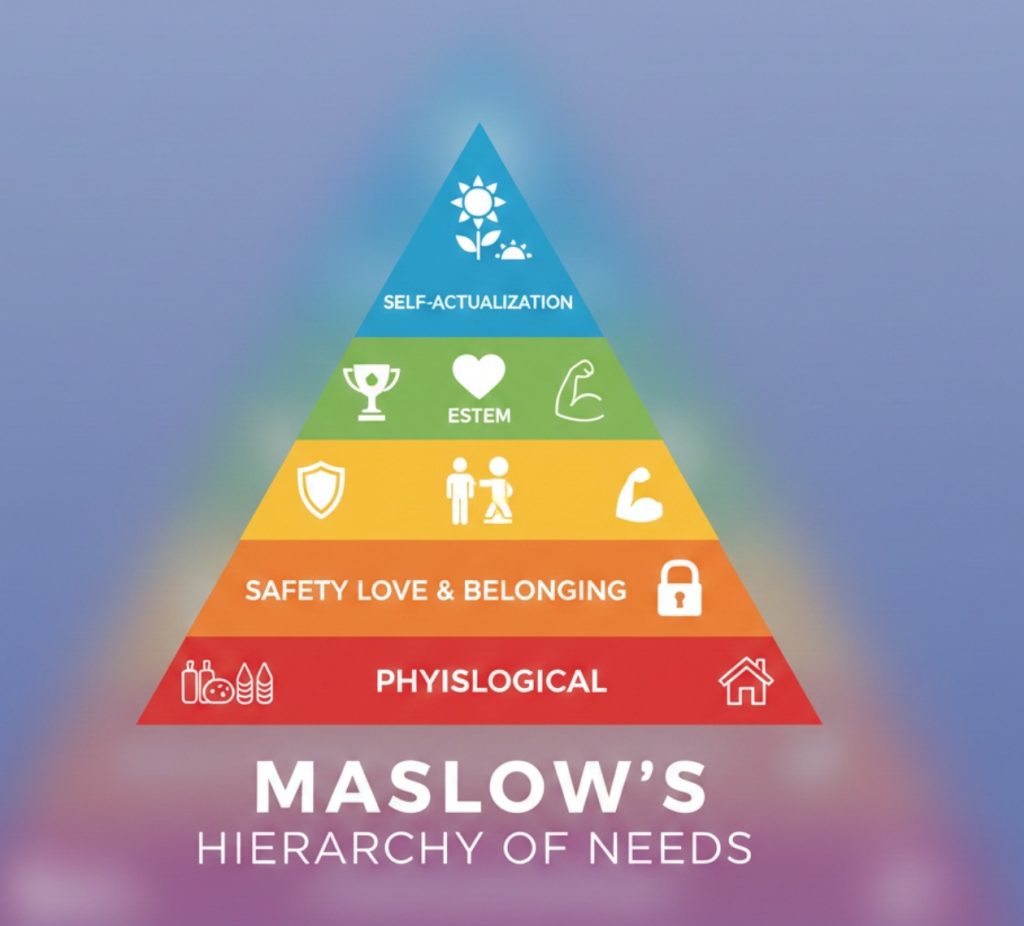
Usually shown as a pyramid with 5 levels, from basic survival to peak human potential.
Think of it like a game: 👉 You can’t unlock the next level if you haven’t passed the previous one.
The 5 Levels of Maslow’s Hierarchy
1. Physiological Needs (Survival Mode 🥖💧)
This is Level 1: Don’t-die needs.
Includes:
- Food
- Water
- Oxygen
- Sleep
- Shelter
- Sex (yes, biologically important)
If these aren’t met, nothing else matters.
🔬 Science angle:
Your brain literally prioritizes survival. When you’re hungry, your hypothalamus activates hunger hormones (like ghrelin), and your focus shifts toward food—not philosophy.
No food = no dreams.
2. Safety Needs (Stability Mode 🛡️)
Once survival is handled, humans want security.
Includes:
- Physical safety
- Financial stability
- Health
- Protection from danger
- Law & order
This is why people:
- Want jobs
- Save money
- Avoid risky situations
- Fear crime and chaos
🧠 Trauma or constant fear can trap people at this level.
That’s why people from unstable environments often prioritize money and safety over passion.
3. Love & Belonging (Social Mode ❤️)
Now we want connection.
Includes:
- Friendship
- Family
- Romantic relationships
- Social acceptance
Humans are tribal animals. Isolation = psychological pain.
🔬 Biology check:
Social bonding releases oxytocin, the “bonding hormone,” which reduces stress and increases trust.
That’s why rejection hurts like hell—it’s evolution screaming:
“Being alone used to mean death.”
4. Esteem Needs (Confidence Mode 👑)
This is where ego enters the chat.
Includes:
- Self-respect
- Confidence
- Achievement
- Recognition
- Status
Two types:
- Internal esteem – confidence, competence
- External esteem – respect, praise, status
This explains:
- Hustle culture
- Flex culture
- Titles, degrees, awards
People want to feel:
“I matter. I’m capable. I’m not invisible.”
5. Self-Actualization (Peak Human Mode 🚀)
This is the top of the pyramid.
It’s about:
- Becoming your best possible self
- Creativity
- Purpose
- Meaning
- Growth
- Truth
Examples:
- Artists creating freely
- Scientists chasing knowledge
- Entrepreneurs building impact
- Philosophers seeking meaning
Maslow described this as:
“What a man can be, he must be.”
Not money. Not fame. Fulfillment.
Is Maslow’s Hierarchy Scientific?
Short answer: Partially.
✔️ What holds up:
- Basic needs clearly affect motivation
- Survival and safety come first (strong biological evidence)
- Social connection is essential for mental health
❌ What’s debated:
- The pyramid isn’t rigid
- People don’t always move in order
- Culture changes priorities
- Some chase meaning even while suffering
Example:
- Poor artists still create
- Soldiers risk safety for values
- Parents sacrifice everything for kids
So modern psychology sees it as a framework, not a rulebook.
Modern Version (Maslow 2.0)
Later in life, Maslow even added more layers:
- Cognitive needs (knowledge, curiosity)
- Aesthetic needs (beauty, order)
- Self-transcendence (helping others, spirituality)
Basically, he upgraded the pyramid.
Why Maslow Still Matters Today
Maslow helps explain:
- Why poverty kills dreams
- Why mental health depends on safety
- Why money matters—but isn’t everything
- Why fulfillment comes last, not first
If someone is struggling, the question isn’t:
“Why aren’t they motivated?”
It’s:
“Which level are they stuck at?”
Final Take
Maslow’s Hierarchy isn’t perfect science—but it’s psychological common sense backed by biology.
You can’t:
- Meditate while starving
- Find purpose while unsafe
- Build confidence without belonging
First survive.
Then stabilize.
Then connect.
Then grow.
Then transcend.
Simple. Human. Real.