
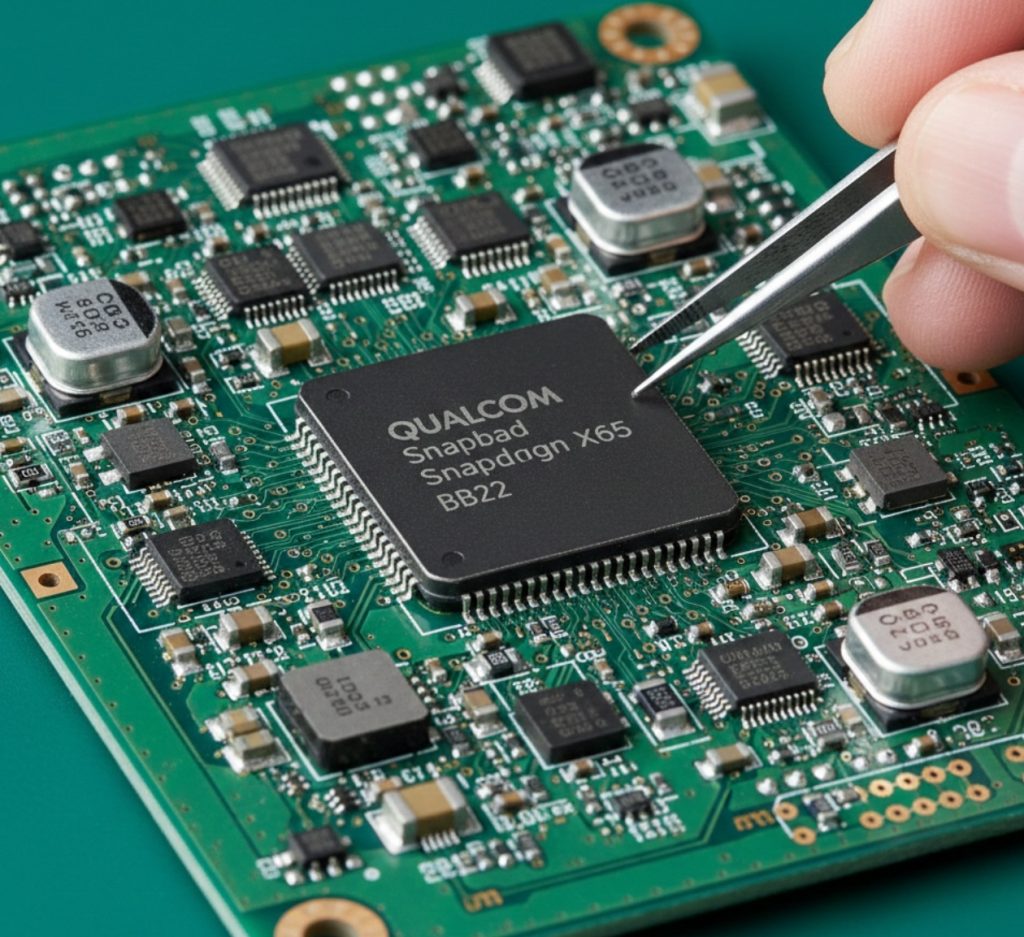
A Baseband IC is an integrated circuit in mobile devices that processes all network communication signals. It manages voice, data, SMS, and cellular connectivity, acting as the bridge between the cellular network and the device’s CPU.
What is a Baseband IC?
- It’s also called a modem chip.
- Handles all radio frequency (RF) signals coming from the cellular antenna.
- Converts network signals into data and voice for the device to process.
- Found in smartphones, tablets, and IoT devices with cellular connectivity.
Other Names:
- Modem IC
- Cellular Processor
- Network Processor
How a Baseband IC Works
- Signal Reception: Receives RF signals from the antenna via the RF front-end module.
- Demodulation: Converts radio signals into digital baseband signals that the device can understand.
- Processing:
- Handles voice coding/decoding (VoLTE, GSM)
- Manages data protocols (4G LTE, 5G NR)
- Handles encryption, error correction, and signal integrity
- Transmission: Converts processed data back to RF signals for sending over the network.
Baseband IC is essentially the “brain of mobile communication”, coordinating how your phone talks to towers.
Types of Baseband IC
1. 2G / 3G Baseband
- Supports GSM, CDMA, UMTS networks.
- Manages voice and basic data communication.
2. 4G LTE Baseband
- Supports high-speed mobile data.
- Handles VoLTE, HD voice, and internet traffic.
3. 5G NR Baseband
- Supports next-generation mobile networks.
- Manages massive data throughput, ultra-low latency, and IoT connections.
4. Multi-mode Baseband
- Can handle 2G, 3G, 4G, and 5G simultaneously.
- Common in modern smartphones for global network compatibility.
Applications of Baseband IC
- Smartphones & Tablets: Voice calls, messaging, internet browsing.
- IoT Devices: Cellular-connected sensors, trackers, and smart meters.
- Routers / Modems: Cellular internet devices for home or portable use.
- Wearables: Smartwatches with LTE connectivity.
Key Features
- Network Handling: Manages all cellular protocols and frequency bands.
- Signal Processing: Handles modulation, demodulation, encoding, and decoding.
- Security: Performs encryption and error correction.
- Multi-mode & Multi-band: Supports multiple generations of mobile networks.
Fun Facts
- Modern smartphones use multi-mode baseband ICs to work in different countries and network generations.
- Baseband ICs work closely with RF transceivers and UEM/PMIC chips to maintain stable connections.
- Some high-end baseband ICs integrate AI and signal optimization algorithms for better call quality and data speed.
Quick Reference
| Type | Feature | Common Use Case |
|---|---|---|
| 2G / 3G Baseband | Basic voice & data | Legacy networks |
| 4G LTE Baseband | High-speed data & VoLTE | Modern smartphones |
| 5G NR Baseband | Ultra-fast data, low latency | Next-gen mobile & IoT devices |
| Multi-mode | Supports 2G-5G | Global smartphones |