
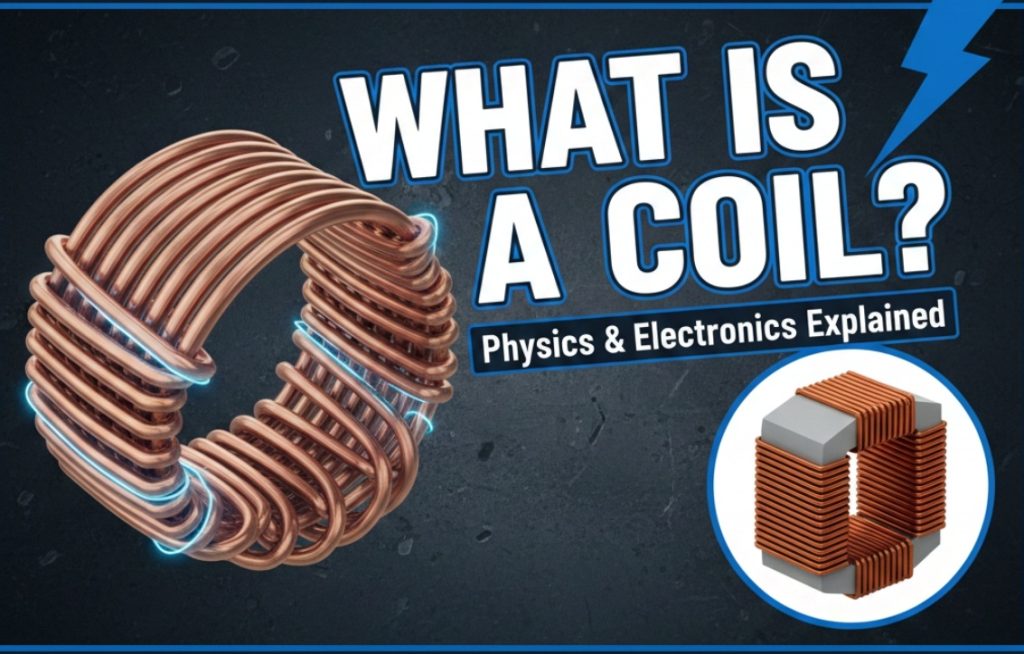
Coils are one of the most important components in electronics. They appear in almost every circuit, from mobile phones and LED drivers to car ignition systems and transformers. Understanding coils is key to understanding how voltage, current, and magnetic fields work together in electronics.
In this blog, we’ll cover:
- What a coil is
- How it works
- Types of coils
- Applications and real-life examples
What Is a Coil?
A coil, also called an inductor, is a wire wound in loops or spirals. When current flows through the coil, it generates a magnetic field, which can store energy, oppose changes in current, or transform voltage and current.
In simple terms:
A coil can increase or decrease voltage and current, depending on its design and application.
Key Functions of a Coil:
- Store electrical energy in a magnetic field
- Boost or reduce voltage
- Boost or reduce current
- Filter signals in circuits
- Produce magnetic effects in devices like relays or electromagnets
How a Coil Works
- When electric current flows through the wire, a magnetic field forms around it.
- If the current changes, the magnetic field changes, which induces a voltage in the coil (Faraday’s Law of Induction).
- This ability to resist sudden changes in current is called inductance (L).
⚡ Inductance: A measure of a coil’s ability to oppose changes in current. Higher inductance means stronger opposition.
Main Types of Coils
Coils are classified based on function, core material, shape, and frequency.
1. Based on Function
🔹 Boost Coil
- Function: Increases voltage, reduces current
- Voltage ↑, Current ↓
- Applications: Car ignition systems, boost converters in electronics
🔹 Buck / Bug Coil
- Function: Reduces voltage, increases current
- Voltage ↓, Current ↑
- Applications: LED drivers, step-down power supplies
🔹 Choke Coil
- Function: Blocks high-frequency AC, passes DC
- Applications: Power supply filters, noise reduction
🔹 Pulse Coil
- Function: Produces short high-voltage pulses
- Applications: Ignition systems, pulse circuits
🔹 RF Coil
- Function: Works in radio frequency circuits
- Applications: Tuning circuits, antennas, radios
2. Based on Core Material
🔹 Air Core Coil
- No magnetic core; only wire
- High-frequency applications
- Low inductance but fast response
🔹 Iron Core Coil
- Wound around iron or steel
- Strong magnetic field → higher inductance
- Used in transformers, power supplies
🔹 Ferrite Core Coil
- Uses ferrite material
- Reduces energy loss and electromagnetic interference
- Common in switching power supplies and high-frequency circuits
3. Based on Shape
🔹 Solenoid Coil
- Cylindrical wire winding
- Used in electromagnets, relays, valves
🔹 Toroidal Coil
- Donut-shaped winding
- Efficient, minimal magnetic leakage
- Used in audio transformers, power supplies
🔹 Pancake Coil
- Flat spiral winding
- Used in wireless charging, induction heating
4. Based on Frequency
🔹 Low-Frequency Coil
- Used in power circuits (50–60 Hz)
- Large inductance, usually iron or ferrite core
🔹 High-Frequency Coil
- Used in radio, TV, mobile circuits
- Air core or ferrite core
- Fast response, smaller size
Summary Table of Coil Types
| Type | Function / Feature | Example / Use |
|---|---|---|
| Boost Coil | Voltage ↑, Current ↓ | Car ignition, boost converters |
| Buck / Bug Coil | Voltage ↓, Current ↑ | LED drivers, battery circuits |
| Choke Coil | Blocks AC, passes DC | Power supply filters |
| Pulse Coil | Produces pulses | Ignition systems, pulse circuits |
| RF Coil | Tuned for radio | Tuning circuits, antennas |
| Air Core | No core, high-frequency | RF circuits, radios |
| Iron Core | Strong magnetic field | Transformers, power circuits |
| Ferrite Core | Reduces EMI, efficient | Switching power supplies |
| Solenoid | Cylindrical, magnetic effect | Relays, valves |
| Toroidal | Donut-shaped, minimal leakage | Power and audio transformers |
| Pancake | Flat spiral | Wireless charging, induction heating |
Real-Life Analogies
- Boost Coil: Pumping water into a high-pressure pipe → increases voltage, reduces flow (current).
- Buck / Bug Coil: Filling a wide tank → reduces voltage, increases flow (current).
- Choke Coil: Acts like a filter, letting some “traffic” pass and blocking others.
Applications of Coils
- Power Electronics: Boost and buck coils regulate voltage and current.
- Ignition Systems: Pulse coils produce high-voltage sparks for engines.
- Power Supplies: Choke coils reduce noise and filter signals.
- Radio & Communication: RF coils tune frequencies and improve signal quality.
- Wireless Charging: Pancake and toroidal coils transfer energy wirelessly.
- Electromagnets: Solenoids create magnetic fields for mechanical motion.
Conclusion
Coils are the backbone of many electrical and electronic devices. They allow engineers to:
- Control voltage and current
- Store energy
- Filter signals
- Produce magnetic effects
Simply put: Coils are the magnetic traffic controllers of electricity — they manage how voltage and current flow, making circuits work efficiently! ⚡🔄