
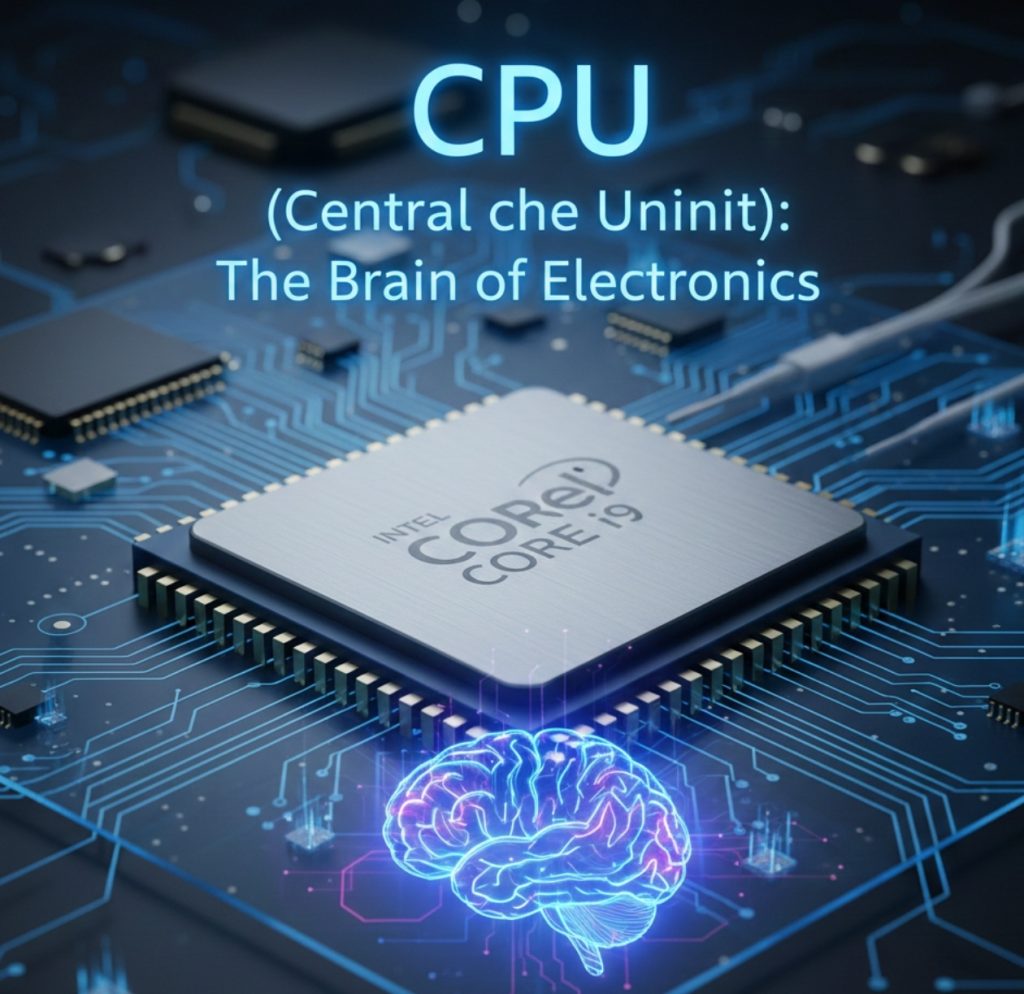
The CPU is the central processing unit of a device—basically the brain that executes instructions, processes data, and controls other components. Without it, your computer, smartphone, or embedded device can’t function.
What is a CPU?
- The CPU is a microprocessor that performs arithmetic, logic, control, and input/output (I/O) operations.
- It interprets instructions from software and coordinates hardware activity.
- Found in computers, smartphones, microcontrollers, and embedded systems.
How a CPU Works
A CPU works in a cycle called the Fetch-Decode-Execute Cycle:
- Fetch: Reads an instruction from memory.
- Decode: Determines what the instruction requires (e.g., add, move, read/write).
- Execute: Performs the operation using ALU, registers, and control units.
- Store / Output: Saves the result back to memory or sends it to a peripheral.
Modern CPUs execute billions of instructions per second!
Components of a CPU
- ALU (Arithmetic Logic Unit):
- Performs arithmetic (add, subtract, multiply) and logical (AND, OR, NOT) operations.
- Control Unit (CU):
- Directs data flow between CPU, memory, and peripherals.
- Decodes instructions and coordinates execution.
- Registers:
- Small, high-speed storage locations for temporary data and instructions.
- Cache Memory:
- Ultra-fast memory inside CPU for frequently used data and instructions.
Types of CPU
1. Based on Architecture
- CISC (Complex Instruction Set Computer): Many complex instructions; example: x86 processors.
- RISC (Reduced Instruction Set Computer): Fewer instructions but faster execution; example: ARM processors.
2. Based on Cores
- Single-Core: One processing unit.
- Multi-Core (Dual, Quad, Octa): Multiple processing units for parallel processing.
3. Based on Application
- Desktop / Laptop CPUs: High-speed processing for general computing.
- Mobile / ARM CPUs: Energy-efficient, optimized for smartphones and tablets.
- Embedded CPUs: Used in IoT, automotive, and appliances.
Applications of CPU
- Computers & Laptops: Runs software, games, and operating systems.
- Smartphones & Tablets: Executes apps, controls display, sensors, and connectivity.
- Embedded Systems: Industrial machines, smart devices, and robots.
- Gaming Consoles: Processes graphics and game logic in real time.
Fun Facts
- Modern CPUs can execute billions of instructions per second (GHz speed).
- Smartphones mostly use ARM-based CPUs for energy efficiency.
- Multi-core CPUs allow parallel processing, making multitasking smooth.
- CPUs today integrate GPU, AI accelerators, and security modules on the same chip.
Quick Reference
| Component | Function |
|---|---|
| ALU | Arithmetic and logic operations |
| Control Unit | Directs data flow and instruction execution |
| Registers | Temporary high-speed data storage |
| Cache Memory | Fast memory for frequently used data |
| CPU Types | CISC, RISC, Single-Core, Multi-Core, Embedded |