
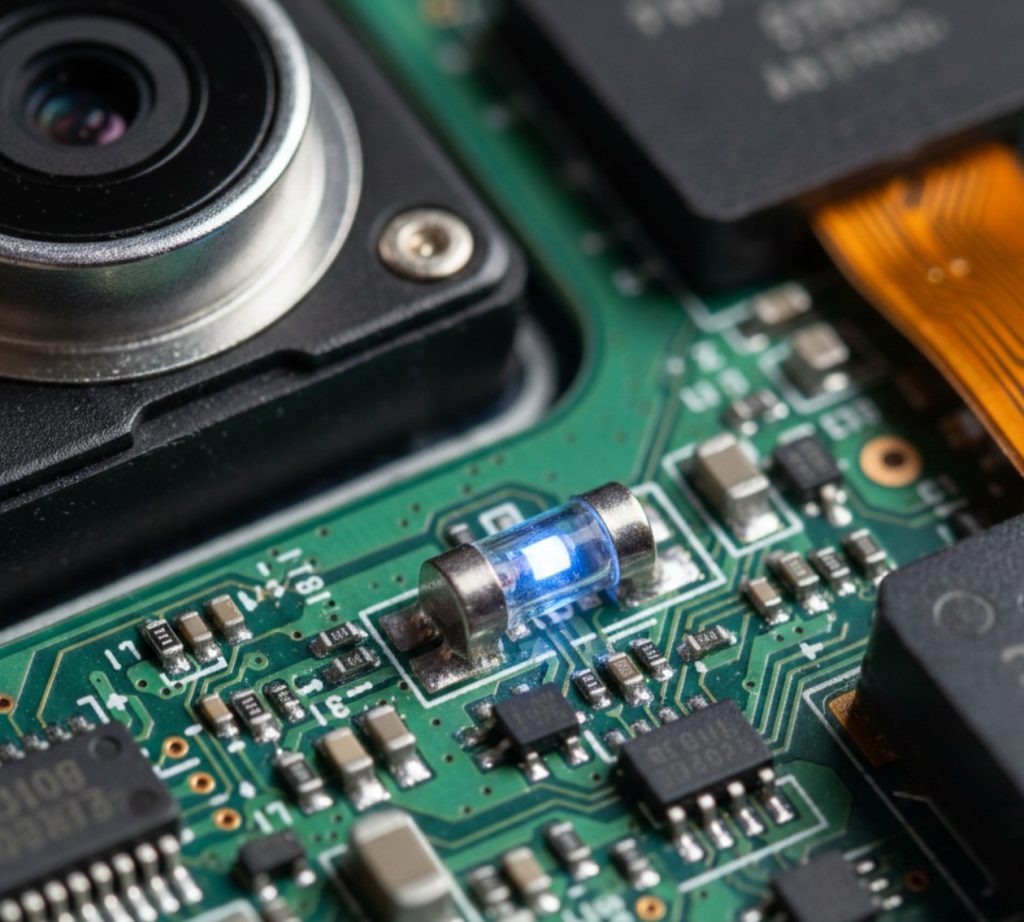
A diode is a fundamental electronic component that allows current to flow in only one direction. Think of it as a one-way street for electrons—essential for controlling current and protecting circuits.
Key Features of a Diode
- Polarity: Has two terminals: Anode (+) and Cathode (-)
- Symbol: Triangle pointing to a line (→|)
- Unit: Voltage drop (typically 0.7V for silicon diodes, 0.3V for germanium)
- Color / Marking: Cathode often marked with a stripe
How a Diode Works
- Forward Bias:
- Anode connected to positive, cathode to negative.
- Current flows freely after overcoming a small voltage drop.
- Reverse Bias:
- Anode connected to negative, cathode to positive.
- Current does not flow (except a tiny leakage current).
Diodes act like a check valve, letting current pass only in one direction.
Types of Diodes
1. Rectifier Diode
- Converts AC to DC (used in chargers, power supplies).
- Can handle high voltage and current.
2. Zener Diode
- Allows current in reverse if voltage exceeds breakdown voltage.
- Used for voltage regulation and protection circuits.
3. Light Emitting Diode (LED)
- Emits light when current passes through.
- Used in displays, indicators, lighting.
4. Schottky Diode
- Low voltage drop (~0.2V) and fast switching.
- Used in high-speed circuits and power applications.
5. Photodiode
- Generates current when exposed to light.
- Used in light sensors, cameras, and optical communication.
6. Tunnel Diode
- Very fast switching diode with negative resistance.
- Used in high-frequency oscillators.
7. Varactor / Varicap Diode
- Capacitance changes with reverse voltage.
- Used in tuning circuits and RF applications.
Applications of Diodes
- Rectification: AC to DC conversion in chargers and adapters.
- Voltage Regulation: Zener diodes keep circuits safe.
- Signal Demodulation: Extracting audio from radio signals.
- Lighting: LEDs for indicators, screens, and illumination.
- Protection: Prevent reverse polarity damage to sensitive components.
Fun Facts
- The first semiconductor diode was invented in the early 20th century using germanium.
- LEDs are more energy-efficient than traditional bulbs and last tens of thousands of hours.
- Schottky diodes are widely used in solar panels to prevent backflow of current at night.
Quick Reference
| Type | Key Feature | Common Use Case |
|---|---|---|
| Rectifier | High current AC→DC | Chargers, adapters |
| Zener | Reverse voltage regulation | Voltage stabilizers |
| LED | Emits light | Indicators, displays |
| Schottky | Low voltage drop, fast switching | High-speed circuits |
| Photodiode | Detects light | Sensors, optical communication |
| Tunnel Diode | Fast switching, negative resistance | High-frequency circuits |
| Varactor/Varicap | Variable capacitance | RF tuning circuits |