
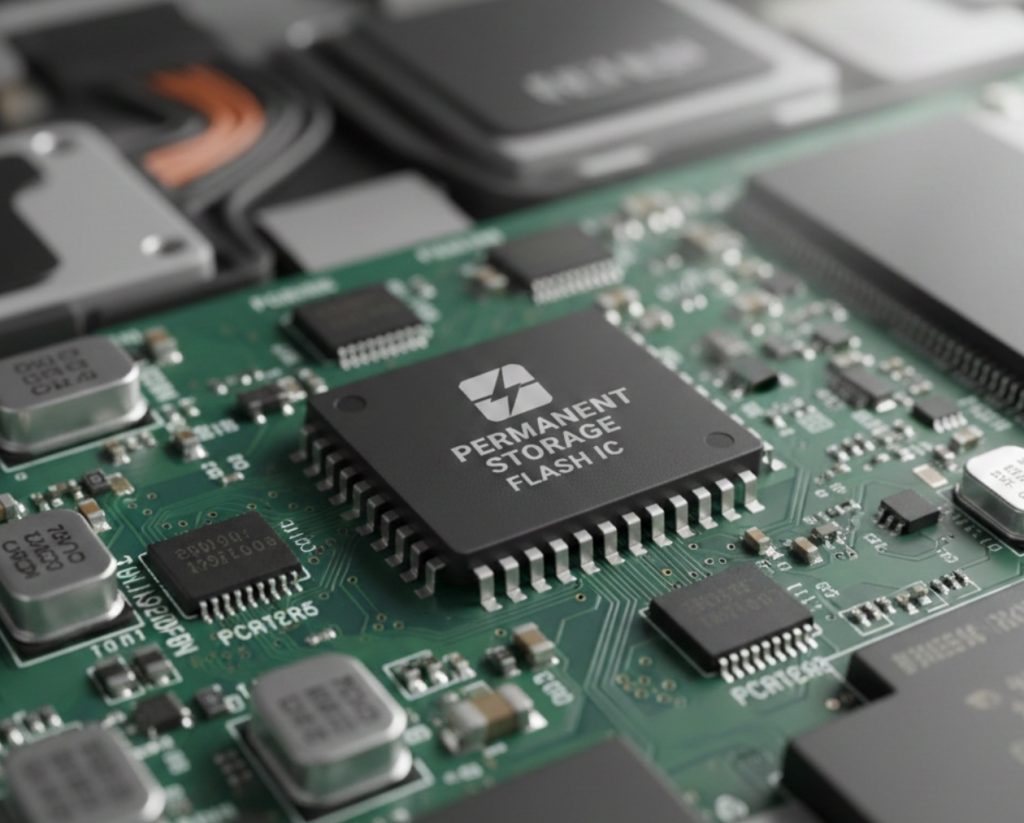
A Flash IC is a type of non-volatile memory that retains data even when the device is powered off. It’s the backbone of modern electronics, used in smartphones, computers, cameras, and many other devices for permanent storage.
What is a Flash IC?
- Stores data permanently (unlike RAM, which is temporary).
- Can be electronically erased and reprogrammed.
- Used for storing operating systems, applications, media files, and other data.
Other Names:
- Storage
- Memory
- NVME
- Flash IC
- ROM (Read-Only Memory)
- NAND
- eMMC
How Flash IC Works
- Memory Cells: Flash IC stores data in cells made of floating-gate transistors.
- Programming: Electrons are trapped in the floating gate to represent binary 1s or 0s.
- Erasing: Electrons can be removed electrically, making the cell ready for new data.
- Reading: Voltage levels are applied to detect whether a cell is charged (1) or uncharged (0).
This allows data to be rewritten thousands of times, while still being retained when power is off.
Types of Flash Memory
1. NAND Flash
- Most common type of storage in smartphones, USB drives, and SSDs.
- High density and fast writing speeds.
2. NOR Flash
- Offers faster read speeds but slower write/erase.
- Used for firmware storage and code execution.
3. EEPROM (Electrical Erasable Programmable ROM)
- Can be individually erased and rewritten.
- Used in iPhones and embedded systems for storing small amounts of critical data.
4. eMMC (Embedded MultiMediaCard)
- Integrated storage chip used in smartphones, tablets, and low-end laptops.
- Combines NAND Flash + controller in one package.
5. NVMe / SSD Storage
- High-speed storage for computers and laptops.
- Uses PCIe interface for faster data transfer.
Popular Flash IC Brands
- Sk Hynix
- Samsung
- SanDisk
- Toshiba
- Micron
Applications of Flash IC
- Smartphones & Tablets: Store OS, apps, photos, videos.
- Computers & Laptops: SSDs and high-speed storage.
- Embedded Systems: Automotive ECUs, IoT devices, and industrial controllers.
- Cameras & Media Devices: Store pictures, videos, and audio files.
Fun Facts
- Flash memory is non-volatile, meaning it keeps data even without power.
- NAND Flash allows millions of write/erase cycles before wearing out.
- EEPROM is widely used in iPhones for storing system-critical data.
- Modern smartphones combine NAND + eMMC or NVMe controllers for better performance.
Quick Reference
| Type | Feature | Common Use Case |
|---|---|---|
| NAND | High density, fast writes | Smartphones, USB drives, SSDs |
| NOR | Fast reads, slower writes | Firmware storage |
| EEPROM | Electrically erasable, small data | iPhones, embedded systems |
| eMMC | NAND + controller integrated | Tablets, budget smartphones |
| NVMe / SSD | High-speed, PCIe interface | Laptops, PCs, high-performance storage |