
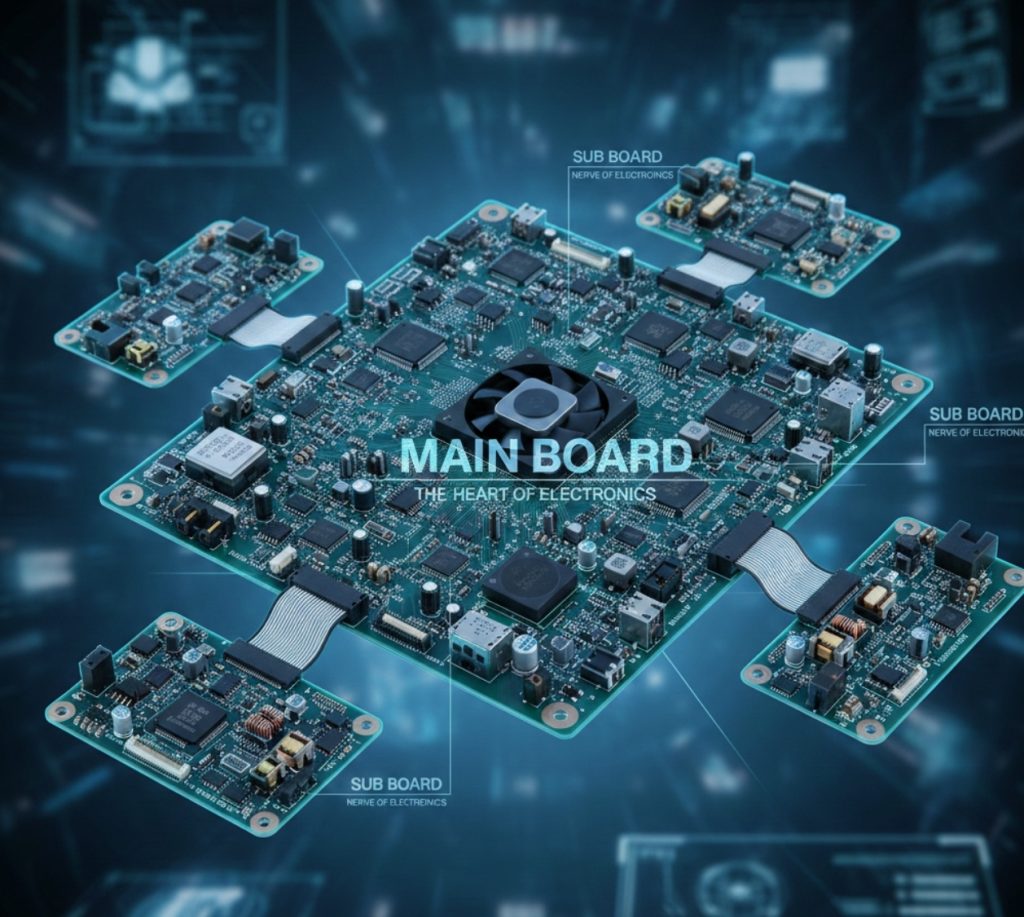
In every modern electronic device—smartphones, laptops, tablets, or IoT gadgets—there’s a hidden infrastructure that keeps everything running smoothly. These are the main board (motherboard) and the sub board (daughterboard). Understanding them helps you see how devices handle processing, connectivity, power, and audio.
What is a Main Board (Motherboard)?
The main board, also called the motherboard, is the primary circuit board in a device. It’s like the central hub where all critical components communicate and work together.
Key Components of a Main Board
- CPU (Central Processing Unit)
- The “brain” of the device.
- Executes instructions, processes data, and controls other components.
- Network Module
- Manages connectivity like Wi-Fi, Ethernet, or mobile networks.
- Ensures your device can send and receive data.
- Power Management Circuit
- Distributes electricity to all components safely.
- Protects the device from voltage fluctuations and manages battery charging.
- Audio Module
- Processes sound signals for speakers and headphones.
- Handles input from microphones and output to audio devices.
Main Board Functions:
- Central hub connecting CPU, memory, storage, and peripherals.
- Ensures smooth communication between components.
- Controls power, audio, and network functions.
What is a Sub Board (Daughterboard)?
A sub board, also called a daughterboard, is a secondary circuit board connected to the main board. It handles specific tasks, often related to input/output or specialized functions.
Key Components of a Sub Board
- Charging Circuit
- Manages battery charging and power input.
- Headphone Jack / Audio Interface
- Connects wired headphones or external audio devices.
- Microphone Module
- Captures sound for calls, recordings, or voice commands.
- Loudspeaker
- Converts audio signals from the main board into sound.
- Antenna Connections
- Provides wireless connectivity for Wi-Fi, Bluetooth, or mobile signals.
Sub Board Functions:
- Handles specialized input/output tasks.
- Keeps bulky or noisy circuits separate from the main board.
- Makes repairs or upgrades easier, as sub boards can often be replaced independently.
How Main & Sub Boards Work Together
- The CPU on the main board processes data and sends instructions to sub boards.
- Sub boards handle specialized tasks like charging, audio input/output, and antenna communication.
- Power is distributed safely from the main board to sub boards and other peripherals.
- Signals from user interactions (touchscreen, microphone, headphones) pass through the sub board and back to the main board for processing.
Think of the main board as the brain and nervous system, while sub boards are the limbs and sensory organs—each specialized, but working together for smooth operation.
Why Separate Main & Sub Boards?
- Compact Design: Helps fit more components into small devices.
- Easier Repairs: Faulty sub boards can be replaced without touching the main board.
- Reduced Interference: Sensitive circuits (like audio or antennas) can be separated from high-power processing circuits.
- Scalability: Manufacturers can upgrade or customize sub boards without redesigning the main board.
Fun Facts
- Modern smartphones often have multiple sub boards for camera modules, charging, and antenna systems.
- High-end devices sometimes use stacked main boards to save space while increasing functionality.
- Separating functions into sub boards helps reduce heat and improve battery efficiency.
Final Thoughts
The main board and sub board architecture is the backbone of modern electronics. The main board handles processing, power, and connectivity, while sub boards manage specialized tasks like charging, audio, and antenna signals. Together, they allow devices to be compact, powerful, and multifunctional—everything from calling and gaming to streaming and navigation.