
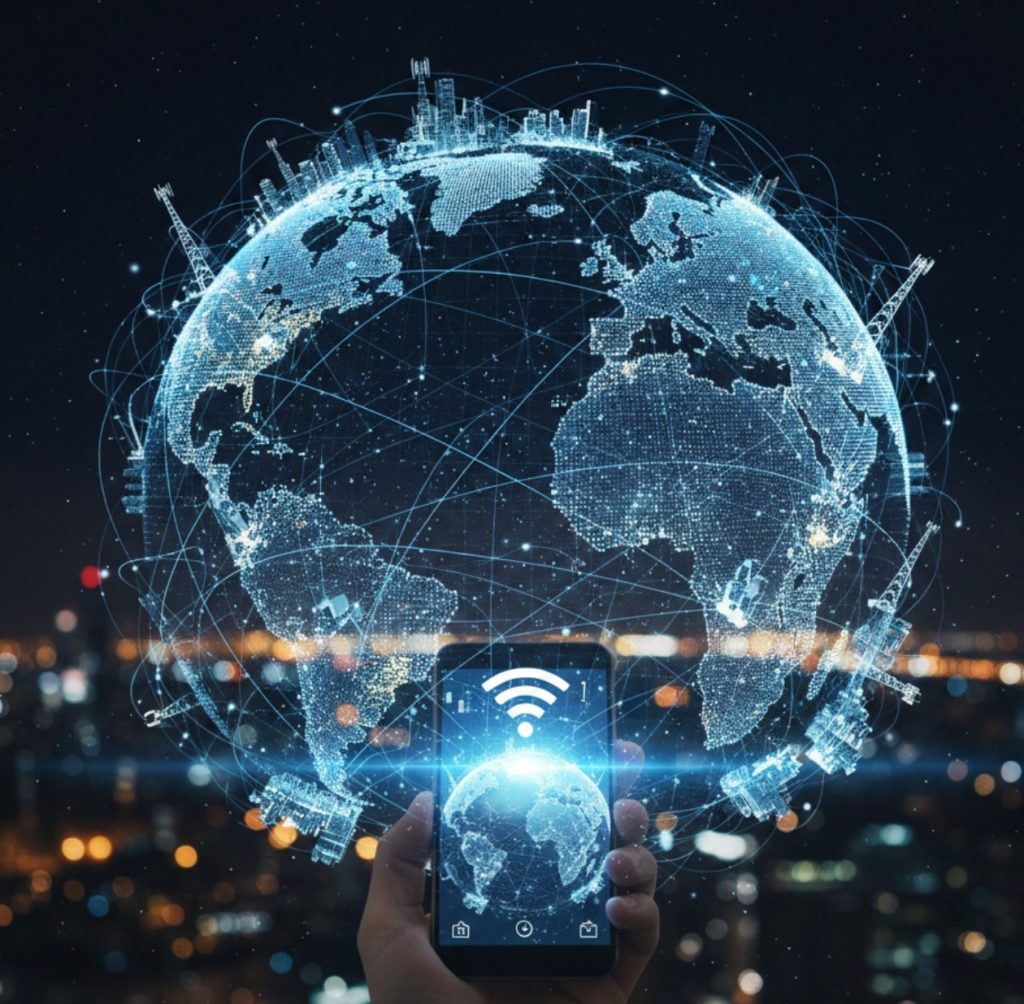
Every time you make a call, send a text, or scroll social media, your phone is communicating with a mobile network. But how does this invisible system work, and how does your data travel from your pocket to the world? Let’s break it down.
What is a Mobile Network?
A mobile network is a system that allows mobile devices (phones, tablets, IoT devices) to communicate wirelessly with each other and with the internet. It is made up of:
Cellular Towers (BTS – Base Transceiver Station)
Network Controller (BTC – Base Transmit Controller)
Core Network (operator infrastructure connecting calls and data globally)
How a Mobile Network Works
Your Phone Sends Signals
Your phone communicates via radio frequency signals.
These signals carry voice, text, or data to the nearest cellular tower.
Cellular Tower (BTS – Base Transceiver Station)
Acts as a wireless relay station.
Receives signals from your phone and forwards them to the network controller.
BTS handles multiple phones in its “cell” area simultaneously.
Network Controller (BTC – Base Transmit Controller)
Coordinates communication between BTS towers.
Manages handovers when you move from one cell to another.
Connects your call or data request to the core network, the internet, or another phone.
Data Transmission
Calls or messages are routed to the recipient through the network.
Internet data goes through the core network, then out to the web.
Essentially, your phone is like a walkie-talkie, BTS is the local tower, and BTC is the traffic controller that ensures your messages and calls reach the right place.
Key Terms
BTS (Base Transceiver Station): The cell tower that communicates directly with mobile devices.
BTC (Base Transmit Controller): Network controller that manages multiple BTS towers and handles routing.
Cell: Area covered by a BTS. Your phone switches between cells as you move.
Frequency Bands: Each network operates on specific radio frequencies (e.g., 900 MHz, 1800 MHz, 2100 MHz).
Types of Mobile Networks
2G (GSM/CDMA): Voice-centric, basic text messaging.
3G (UMTS/CDMA2000): Improved data speeds for internet and multimedia.
4G (LTE): High-speed mobile internet, HD streaming, fast downloads.
5G: Ultra-fast data, low latency, supports IoT, AR/VR, and smart cities.
Fun Facts
Mobile networks divide cities and towns into cells, which is why it’s called a “cellular network.”
When you move, your phone switches between BTS towers seamlessly, called a handover.
Each frequency band can carry multiple simultaneous calls and data connections.
Final Thoughts
Mobile networks are the invisible highways that carry your calls, messages, and internet traffic. From your phone to the BTS tower, then BTC, and finally to the global network, this chain ensures you stay connected anytime, anywhere.