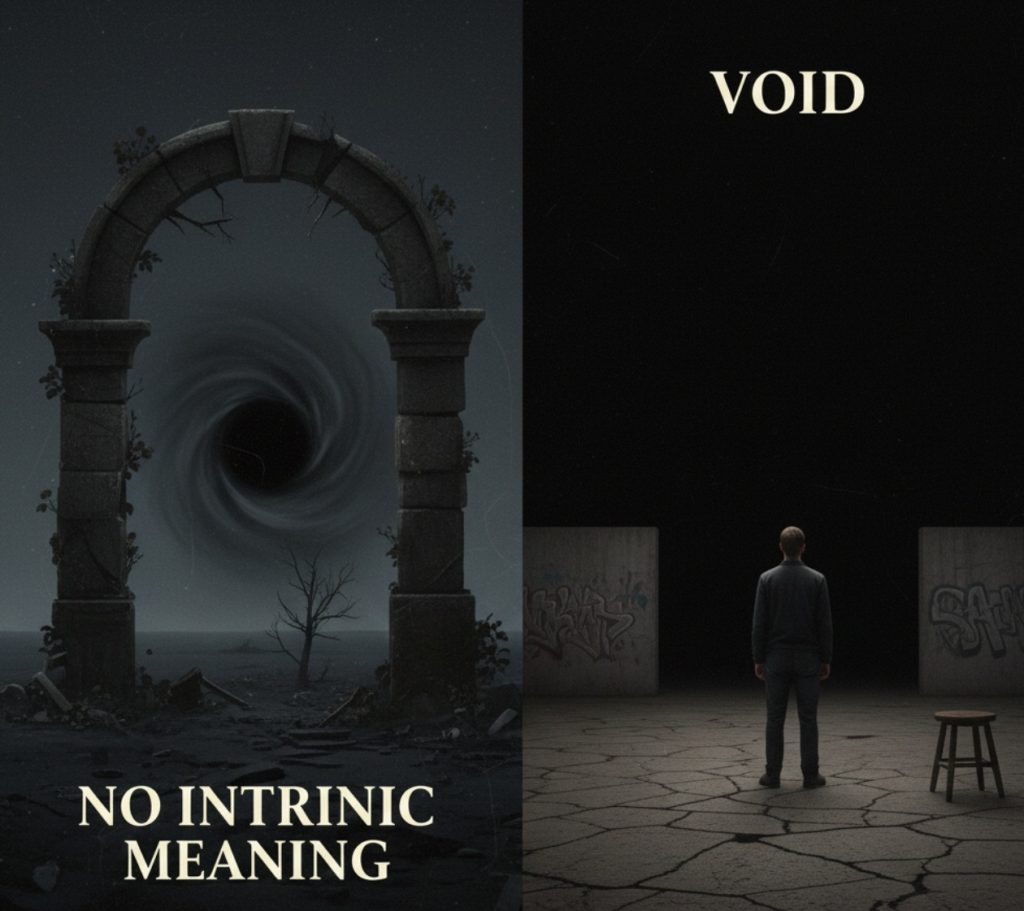
Nihilism often gets painted as dark or depressing, but it’s actually a philosophical stance about meaning, knowledge, and values. At its core, nihilism says: nothing has intrinsic meaning, value, or purpose.
What is Nihilism?
The term comes from the Latin nihil, meaning “nothing.” It’s more than just a mood — it’s a framework for thinking about life, knowledge, and morality.
Philosophers like Friedrich Nietzsche explored nihilism in the 19th century, pointing out that traditional moral and religious systems could no longer provide unquestioned meaning for modern humans.
Types of Nihilism
- Existential Nihilism
- Life has no inherent purpose.
- You decide your own meaning or accept that there might be none.
- Moral Nihilism (Ethical Nihilism)
- There are no absolute moral truths — right and wrong are human constructs.
- Epistemological Nihilism
- Knowledge is impossible or uncertain; we can’t truly “know” anything.
- Political Nihilism
- Rejection of established social and political structures; historically linked to revolutionary movements.
How Nihilism Affects Perspective
- Freedom & Responsibility: If life has no inherent meaning, you’re free to create your own purpose.
- Coping with uncertainty: Accepting that answers might not exist can reduce anxiety over “ultimate truths.”
- Potential pessimism: Without belief in inherent meaning, some feel aimless, depressed, or disconnected.
- Creativity & self-definition: Some find nihilism liberating — it’s a blank canvas to define values and goals.
Nihilism vs. Existentialism
People often confuse nihilism with existentialism:
- Nihilism: Life has no inherent meaning.
- Existentialism: Life has no inherent meaning but you can create your own.
Existentialism is essentially nihilism with a creative, action-oriented twist.
Common Misconceptions
- “Nihilists hate life.” Not necessarily — many are reflective, not misanthropic.
- “Nihilism equals chaos.” It can inform moral choices, not dictate them.
- “Nihilists can’t find happiness.” On the contrary, some find joy precisely because they define their own purpose.
Fun Fact
- Nietzsche warned about “the death of God” — a metaphor for declining faith in traditional values — as the root of modern nihilism.
- Modern culture references: nihilism shows up in movies like The Big Lebowski and in memes like “life is meaningless, man.”
Takeaway
Nihilism isn’t just gloom — it’s a tool for reflection. It asks you to confront the big questions: What really matters? What do I choose to value? While it can feel heavy, it can also be liberating, empowering you to create your own meaning in a world that doesn’t provide one for you.
Do you Alright Bro, let’s tackle nihilism — it’s edgy, deep, and can be super thought-provoking. Here’s a blog-ready version:
Nihilism: When Life Has No “Inherent” Meaning
Nihilism often gets painted as dark or depressing, but it’s actually a philosophical stance about meaning, knowledge, and values. At its core, nihilism says: nothing has intrinsic meaning, value, or purpose.
What is Nihilism?
The term comes from the Latin nihil, meaning “nothing.” It’s more than just a mood — it’s a framework for thinking about life, knowledge, and morality.
Philosophers like Friedrich Nietzsche explored nihilism in the 19th century, pointing out that traditional moral and religious systems could no longer provide unquestioned meaning for modern humans.
Types of Nihilism
- Existential Nihilism
- Life has no inherent purpose.
- You decide your own meaning or accept that there might be none.
- Moral Nihilism (Ethical Nihilism)
- There are no absolute moral truths — right and wrong are human constructs.
- Epistemological Nihilism
- Knowledge is impossible or uncertain; we can’t truly “know” anything.
- Political Nihilism
- Rejection of established social and political structures; historically linked to revolutionary movements.
How Nihilism Affects Perspective
- Freedom & Responsibility: If life has no inherent meaning, you’re free to create your own purpose.
- Coping with uncertainty: Accepting that answers might not exist can reduce anxiety over “ultimate truths.”
- Potential pessimism: Without belief in inherent meaning, some feel aimless, depressed, or disconnected.
- Creativity & self-definition: Some find nihilism liberating — it’s a blank canvas to define values and goals.
Nihilism vs. Existentialism
People often confuse nihilism with existentialism:
- Nihilism: Life has no inherent meaning.
- Existentialism: Life has no inherent meaning but you can create your own.
Existentialism is essentially nihilism with a creative, action-oriented twist.
Common Misconceptions
- “Nihilists hate life.” Not necessarily — many are reflective, not misanthropic.
- “Nihilism equals chaos.” It can inform moral choices, not dictate them.
- “Nihilists can’t find happiness.” On the contrary, some find joy precisely because they define their own purpose.
Fun Fact
- Nietzsche warned about “the death of God” — a metaphor for declining faith in traditional values — as the root of modern nihilism.
- Modern culture references: nihilism shows up in movies like The Big Lebowski and in memes like “life is meaningless, man.”
Takeaway
Nihilism isn’t just gloom — it’s a tool for reflection. It asks you to confront the big questions: What really matters? What do I choose to value? While it can feel heavy, it can also be liberating, empowering you to create your own meaning in a world that doesn’t provide one for you.
If you want, I can also make a “Nihilism Cheat Sheet” for your blog — types, key philosophers, misconceptions, and modern relevance, all in a scroll-friendly visual.