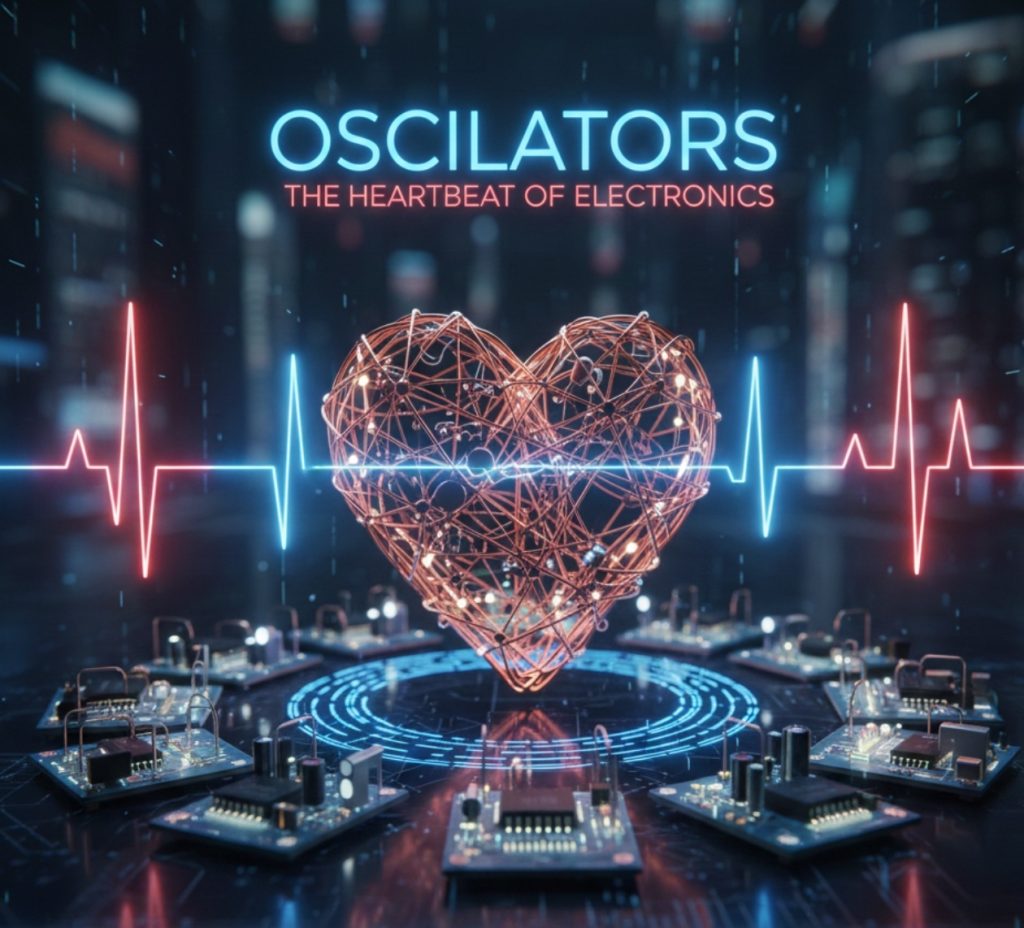
An oscillator is an electronic circuit that produces a repetitive, oscillating signal, usually in the form of sine waves, square waves, or other periodic signals. They are essential in clocks, radios, computers, and communication systems.
What is an Oscillator?
An oscillator generates a continuous output signal without an external input signal. It converts DC power into AC signals at a desired frequency.
- Frequency is measured in Hertz (Hz).
- Signal can be analog (sine wave) or digital (square/triangle wave).
Think of an oscillator as the “heartbeat” of electronics, keeping devices in sync and running at precise speeds.
How an Oscillator Works
Oscillators work using feedback and energy storage:
- Amplification: An active component (transistor, op-amp, or IC) amplifies signals.
- Feedback Loop: Part of the output is fed back to the input.
- Energy Storage: Components like capacitors and inductors determine the frequency of oscillation.
- Continuous Signal: The feedback maintains a stable, repetitive waveform.
Key principle: Positive feedback sustains the oscillations.
Types of Oscillators
1. Based on Output Signal
- Sine Wave Oscillator: Produces smooth analog signals. Examples: LC oscillator, RC phase-shift oscillator.
- Square Wave Oscillator: Produces digital waveforms. Example: Crystal oscillator in microcontrollers.
- Triangle / Sawtooth Oscillator: Used in waveform generators and audio synthesizers.
2. Based on Frequency Control
- RC Oscillator: Uses resistors and capacitors; suitable for low-frequency signals.
- LC Oscillator: Uses inductors and capacitors; used for RF (radio frequency) signals.
- Crystal Oscillator: Uses quartz crystal; extremely precise frequency.
- Relaxation Oscillator: Charges and discharges a capacitor to produce low-frequency signals; simple design.
Applications of Oscillators
- Clocks and Timers: Microcontroller and computer timing circuits.
- Communication: RF signals for radios, TV, and mobile networks.
- Signal Generators: Test and measurement equipment.
- Audio Electronics: Tone generation in synthesizers and alarms.
- Computers: Provides clock signals to synchronize operations.
Fun Facts
- Quartz crystals in watches are oscillators that keep time with extreme precision.
- Oscillators are at the core of all wireless communication, generating carrier waves.
- Some oscillators can produce frequencies from fractions of Hz to several GHz.
Quick Reference
| Type | Principle / Components | Frequency Range | Common Use Case |
|---|---|---|---|
| RC Oscillator | Resistors + Capacitors | Low (<1 MHz) | Audio circuits, timers |
| LC Oscillator | Inductor + Capacitor | Medium – RF | Radio transmitters/receivers |
| Crystal Oscillator | Quartz crystal | High, precise | Computers, watches |
| Relaxation Oscillator | Capacitor charging cycle | Low | Flashers, tone generators |
| Square / Triangle | Active component + feedback | Digital / analog | Microcontrollers, waveform generators |