
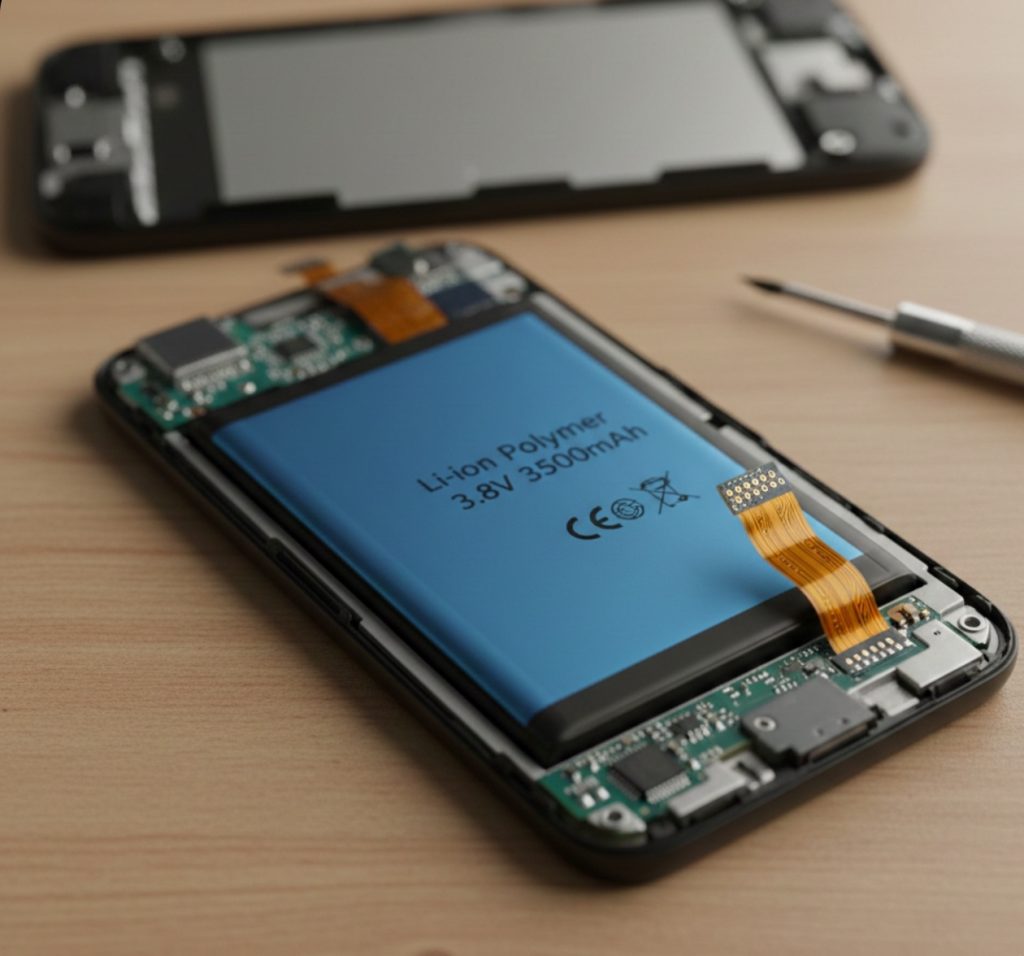
Your smartphone is basically a pocket-sized computer, and none of its apps, calls, or games would work without a battery. Phone batteries are specially designed to be lightweight, rechargeable, and powerful, giving you hours of usage in a tiny package.
What is a Phone Battery?
A phone battery is a rechargeable energy source that powers your smartphone. Unlike standard batteries for remotes or flashlights, phone batteries are compact, high-energy, and designed for repeated charging cycles.
They convert chemical energy into electrical energy to supply voltage and current to your phone’s components: CPU, display, network, sensors, and more.
How Does a Phone Battery Work?
Phone batteries are mostly lithium-based, and they work using electrochemical reactions:
- Anode (Negative Electrode): Releases lithium ions during discharge.
- Cathode (Positive Electrode): Receives lithium ions during discharge.
- Electrolyte: Medium that allows lithium ions to move between the anode and cathode.
- Separator: Keeps anode and cathode physically apart while allowing ion flow.
Charging & Discharging
- Discharging (Using the Battery):
- Lithium ions move from the anode to the cathode through the electrolyte.
- Electrons flow through your phone’s circuits, powering apps, screen, and sensors.
- Charging:
- External electricity pushes lithium ions back to the anode.
- The chemical reaction reverses, storing energy for future use.
Modern phones include battery management systems (BMS) to protect against overcharging, overheating, and excessive discharge.
Types of Phone Batteries
1. Lithium-Ion (Li-ion)
- Most common type used in smartphones and laptops.
- Pros: High energy density, lightweight, long lifespan.
- Cons: Can degrade over time, sensitive to heat.
2. Lithium-Polymer (Li-Po)
- Advanced version of Li-ion with a gel-like electrolyte instead of liquid.
- Pros: Flexible shapes, lightweight, safer in thin devices.
- Cons: Slightly lower energy density than Li-ion.
3. Older Types (Mostly Obsolete)
- NiMH (Nickel-Metal Hydride): Rare in phones today, less energy dense.
- NiCd (Nickel-Cadmium): Early rechargeable tech, had memory effect issues.
Battery Capacity
- Measured in mAh (milliampere-hour), which tells you how much charge the battery can hold.
- Example: A 4000 mAh battery can supply 4000 milliamps for 1 hour or 2000 milliamps for 2 hours.
- Bigger mAh usually means longer usage, but efficiency also depends on phone components.
Tips to Maximize Phone Battery Life
- Avoid extreme heat or cold.
- Don’t let your battery drop to 0% frequently; recharge at 20–80% for longevity.
- Use original chargers or certified fast chargers.
- Close unused apps and reduce screen brightness to save power.
Fun Facts
- Modern phone batteries last about 300–500 full charge cycles before noticeable degradation.
- Fast charging uses higher voltage or current but can slightly reduce long-term lifespan.
- Some phones now have graphene or solid-state batteries in testing for higher capacity and safety.
Final Thoughts
Phone batteries are the heart of your smartphone, converting chemical energy into electrical energy to keep all features running. Understanding how they work helps you take care of your battery, improve lifespan, and choose the right phone for your usage.