
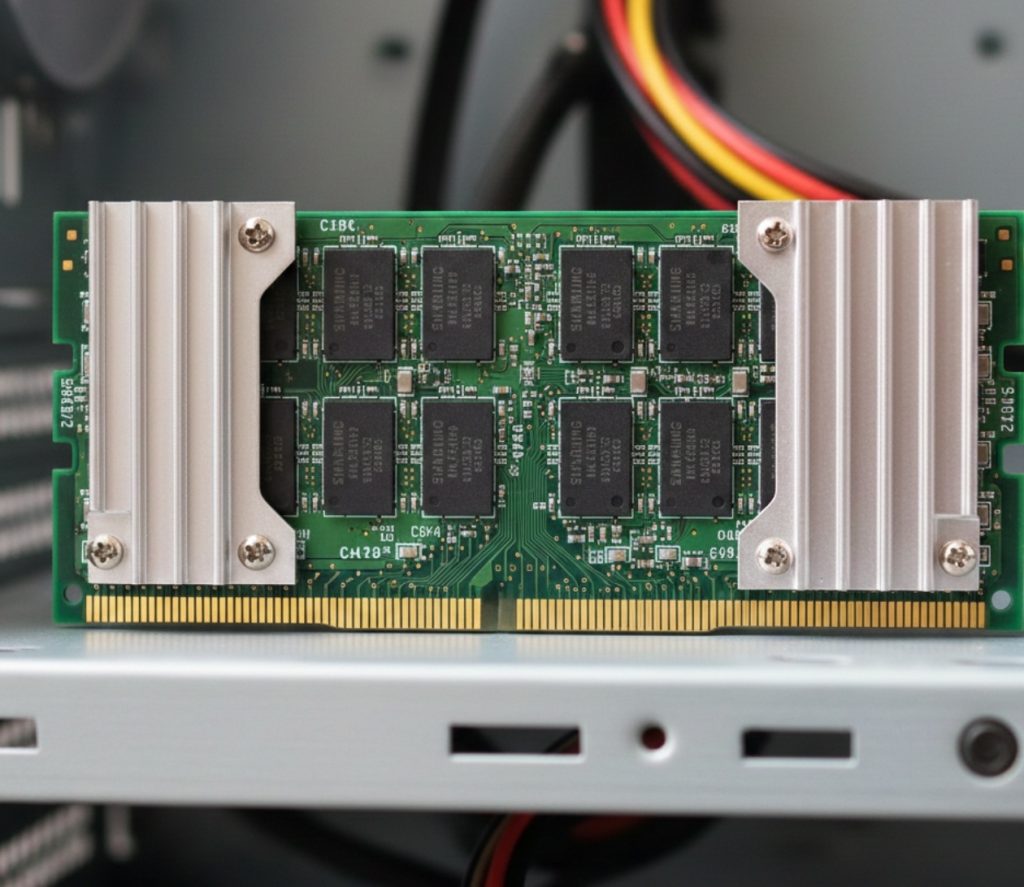
RAM (Random Access Memory) is a type of volatile memory that stores data temporarily while a device is running. It allows devices to access and process data quickly, making your phone, computer, or tablet fast and responsive.
What is RAM?
- Volatile memory: loses data when power is off.
- Provides fast read/write access for active programs, apps, and processes.
- Works alongside permanent storage (Flash IC, SSD) to give smooth performance.
Other Names:
- Memory
- Working Memory
- DRAM (Dynamic RAM)
- SRAM (Static RAM)
How RAM Works
- Data Storage: RAM stores data in memory cells that can be accessed in any order.
- Read/Write: The CPU reads instructions and writes temporary data to RAM for fast processing.
- Volatility: Once the device is powered off, all RAM content disappears, unlike Flash IC.
Think of RAM as your short-term memory, while Flash IC/SSD is your long-term memory.
Types of RAM
1. DRAM (Dynamic RAM)
- Stores data using capacitors, which need constant refreshing.
- Common in PCs, laptops, and smartphones.
2. SRAM (Static RAM)
- Stores data in flip-flop circuits, no refreshing required.
- Faster and more expensive than DRAM.
- Used in CPU caches, registers, and small high-speed memory.
3. SDRAM (Synchronous DRAM)
- Synchronized with the system clock for faster performance.
- Common in desktops, laptops, and servers.
4. DDR (Double Data Rate) RAM
- Transfers data twice per clock cycle, improving speed.
- Versions: DDR1, DDR2, DDR3, DDR4, DDR5
- Used in computers, laptops, and high-performance devices.
5. LPDDR (Low Power DDR)
- Optimized for mobile devices to reduce power consumption.
- Versions: LPDDR2, LPDDR3, LPDDR4, LPDDR5.
Applications of RAM
- Computers & Laptops: Run operating systems and applications smoothly.
- Smartphones & Tablets: Enable multitasking and app performance.
- Embedded Systems: Temporary storage for calculations and data processing.
- Gaming Consoles: Fast data access for games and graphics rendering.
Key Features
- Volatile memory: Data disappears when power is off.
- High-speed access: Much faster than Flash or hard drives.
- Temporary storage: Stores active programs, caches, and temporary files.
- Types vary by speed and power efficiency: SRAM, DRAM, DDR, LPDDR.
Fun Facts
- A computer without RAM cannot run any programs—it’s useless.
- Smartphones use LPDDR to save battery while maintaining performance.
- DDR5 RAM can reach speeds of over 8,000 MHz, making gaming and data processing super fast.
Quick Reference
| Type | Feature | Common Use Case |
|---|---|---|
| DRAM | Needs refreshing, high density | PCs, laptops, smartphones |
| SRAM | No refreshing, very fast | CPU cache, registers |
| SDRAM | Synchronized with system clock | Computers, servers |
| DDR / LPDDR | Double Data Rate, low power | PCs, laptops, smartphones |