Why humans and animals are wired to want sex — no myths, no shame, just biology
Sex isn’t just about pleasure, romance, or culture. Strip all that away and you’ll find something far more ancient and powerful underneath: survival.
From bacteria to bonobos to humans scrolling dating apps at 2 a.m., sex exists because without it, life ends. This blog breaks down — scientifically and psychologically — why sexual desire evolved, how the brain drives it, and why both humans and animals are biologically programmed to want sex.
No philosophy. No moral debate. Just evolution doing its thing.
Sex as a survival necessity — reproduce or disappear
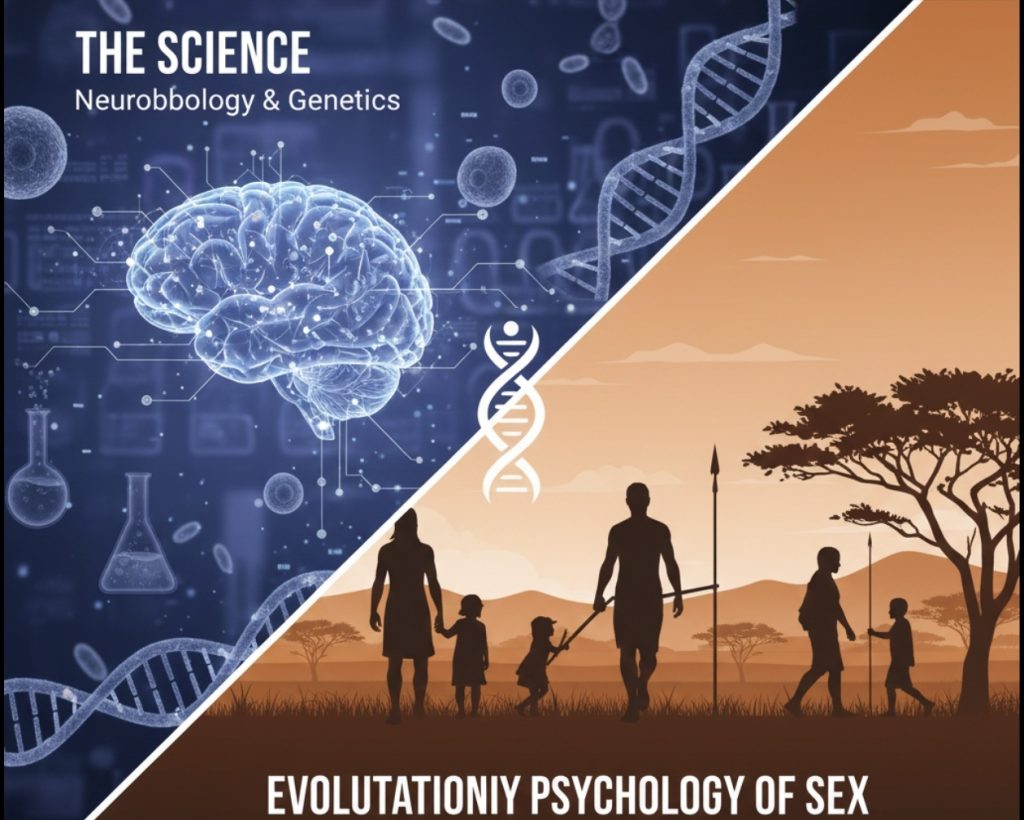
From an evolutionary psychology perspective, sex was not optional — it was a survival requirement. Species that failed to reproduce did not adapt slowly or fade peacefully; they went extinct. Every organism alive today exists only because its ancestors successfully mated and passed on their DNA. Those that didn’t were permanently removed from the gene pool.
Because extinction is absolute, natural selection strongly favored brains that prioritized reproduction. Evolution didn’t rely on conscious reasoning like “we must reproduce to survive as a species.” Instead, it built powerful biological drives — sexual desire, attraction, pleasure, and bonding — to ensure mating occurred consistently across generations.
In this sense, sex is not merely a behavior; it is a continuity mechanism. Without sexual motivation, populations collapse. With it, genes move forward in time. From evolution’s point of view, reproduction equals survival, and sex is the tool that made survival possible.
Why desire exists at all (evolution’s clever trick)
Reproduction is expensive and risky:
- It consumes energy
- It exposes organisms to danger
- Pregnancy and childbirth can be life-threatening
- Parenting demands time and resources
If reproduction depended on logic alone, it would fail.
So evolution did something smarter: it attached reproduction to reward.
Instead of telling the brain:
“You must pass on your DNA.”
Evolution made the brain say:
“This feels amazing. Do it again.”
That’s why desire feels emotional, urgent, and sometimes irrational. It evolved before language, culture, and logic.
The brain chemistry behind sexual motivation
Sex is powered by some of the most ancient systems in the brain.
🧠 Dopamine — the motivation engine
- Dopamine evolved to reinforce survival behaviors: eating, bonding, and sex
- Sexual cues trigger dopamine release
- Dopamine increases focus, craving, and pursuit
This teaches the brain:
Sex = reward = repeat behavior
🧠 Oxytocin — the bonding chemical
- Released during touch, orgasm, and intimacy
- Promotes trust, attachment, and pair-bonding
- Helps keep partners together long enough to raise offspring
🧠 Endorphins — pleasure and relief
- Reduce pain
- Create euphoria and relaxation
- Reinforce positive memory of sexual activity
Together, these chemicals turn sex into a high-priority biological mission.
Pleasure is the incentive — not the goal
A common misunderstanding is thinking sex evolved for pleasure.
Evolutionary psychology says the opposite:
- Goal: Pass on DNA
- Method: Desire and pleasure
- Outcome: Reproduction
Pleasure is not accidental — it’s the biological bribe that ensures organisms reproduce willingly and repeatedly.
This is why sexual urges can override fear, logic, and long-term planning. Evolution valued reproduction more than comfort.
Sexual selection: why animals (and humans) compete and attract
Beyond just mating, evolution shaped how organisms attract partners.
In animals:
- Peacocks grow massive tails to attract mates
- Deer fight with antlers for access to females
- Birds of paradise perform complex dances
- Bowerbirds build decorative structures to impress females
These traits exist because they increase mating success, even if they’re costly or risky.
In humans:
- Physical attraction
- Status and resources
- Confidence and social dominance
- Intelligence and creativity
Different traits signal genetic fitness, safety, or resource potential, depending on context.
Why sex feels urgent and hard to ignore
Sexual desire comes from ancient brain regions:
- Hypothalamus
- Limbic system
These systems evolved millions of years before the rational prefrontal cortex.
So when desire hits, it doesn’t politely ask for permission. It pushes.
Evolution prioritized:
“Reproduce now”
over
“Think carefully about long-term consequences”
That’s not weakness — that’s design.
Humans vs animals: what’s different?
Humans share the same biological drives as animals, but with added layers:
- Culture
- Morality
- Language
- Technology
- Contraception
This creates a mismatch:
- Ancient sexual drives
- Modern social rules
That’s why sex can feel confusing, emotional, and conflicted in humans — the hardware is ancient, the software is new.
Final takeaway: sex is survival in disguise
From an evolutionary psychology standpoint:
- You are a temporary carrier of genes
- Sexual desire is the engine
- Pleasure is the fuel
- Reproduction is the destination
Sex feels powerful because it had to be. Without it, life wouldn’t continue. No desire, no mating. No mating, no future.
Sex isn’t dirty.
It isn’t weak.
It isn’t accidental.
It’s one of evolution’s most successful survival strategies.