
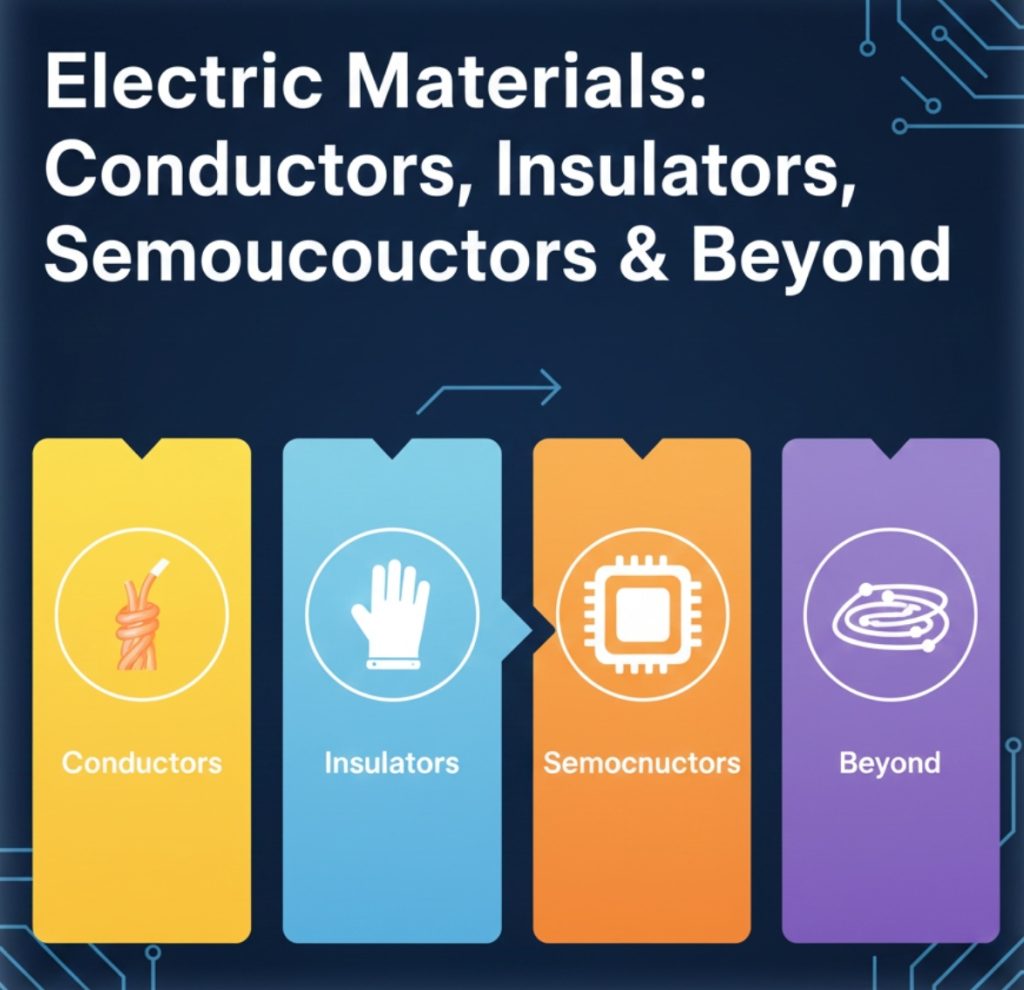
Electricity powers our modern world, but not all materials let it flow the same way. Some are like VIPs letting electricity party freely, some are strict bouncers stopping the flow, and some are smart gatekeepers controlling when it can move. Let’s break down the electric material squad so you’ll understand how our tech universe really works.
1. Conductors: The VIPs of Electricity 🟢
Definition: Conductors are materials that allow electric current to flow easily. They have electrons that are free to move, making it simple for electricity to do its job.
Examples: Copper, Silver, Aluminum, Gold.
Uses:
- Electrical wires and circuits
- Power lines and transformers
- Everyday electronics
Fun Analogy: Imagine a water slide—smooth and slippery. That’s how electricity flows through a conductor, fast and effortless.
2. Insulators: The Bouncers of Electricity 🔴
Definition: Insulators are materials that block or resist the flow of electricity. Their electrons are tightly bound and don’t move freely.
Examples: Rubber, Glass, Plastic, Dry Wood.
Uses:
- Safety coatings on wires and cables
- Electrical appliances and sockets
- Preventing accidental shocks
Fun Analogy: Think of insulators like a strict bouncer at a club. No free passage—electricity isn’t getting in without a special reason.
3. Semiconductors: The Smart Gatekeepers 🟡
Definition: Semiconductors are materials that sometimes allow electricity to flow and sometimes don’t, depending on conditions like temperature, light, or chemical “doping.”
Examples: Silicon, Germanium, Gallium Arsenide.
Uses:
- Microchips in phones, computers, and laptops
- LEDs and solar panels
- Transistors and sensors
Fun Analogy: Semiconductors are like a security gate that only opens when you swipe the correct key card. They control electricity flow with precision, making modern electronics possible.
4. Superconductors: The Zero-Resistance Legends ✨
Definition: Superconductors are materials that, when cooled below a critical temperature, let electricity flow without any resistance at all.
Examples: Niobium-tin, YBCO (high-temperature superconductors).
Uses:
- MRI machines in hospitals
- Maglev trains that levitate and move frictionlessly
- Particle accelerators
Fun Fact: Superconductors can make magnets float in mid-air! That’s real-world “magical levitation.”
5. Electrolytes: The Ionic Express 💧
Definition: Electrolytes are materials that carry electricity through ions instead of electrons.
Examples: Saltwater, acids, battery solutions.
Uses:
- Batteries and fuel cells
- Electroplating
- Conductive solutions in labs
Fun Analogy: Imagine a river of charged particles moving in a stream—that’s electricity flowing through electrolytes.
6. Dielectrics: The Energy Stashers 🛡️
Definition: Dielectrics are special insulators used in capacitors to store energy in an electric field. They block direct current but can store energy for later use.
Examples: Ceramic, Mica, Glass.
Uses:
- Capacitors in electronic circuits
- Energy storage
- Voltage stabilization
Fun Analogy: Dielectrics are like a water balloon—they can store energy and release it when needed.
Quick Comparison Table
| Material Type | Electricity Flow | Examples | Use |
|---|---|---|---|
| Conductor 🟢 | Easy | Copper, Silver | Wires, circuits |
| Insulator 🔴 | Blocked | Rubber, Glass | Safety coatings, protection |
| Semiconductor 🟡 | Conditional | Silicon, Germanium | Chips, LEDs, solar panels |
| Superconductor ✨ | Zero resistance | Niobium-tin, YBCO | MRI, maglev trains |
| Electrolyte 💧 | Ionic flow | Saltwater, acids | Batteries, fuel cells |
| Dielectric 🛡️ | Stores energy | Ceramic, Mica, Glass | Capacitors, voltage stabilizers |
Bottom Line
From the free-flowing conductors to the strict bouncers (insulators), the smart semiconductors, zero-resistance superconductors, ionic electrolytes, and energy-stashing dielectrics—each material plays a crucial role in our electrical universe.
Without them, there would be no phones, no computers, no electric cars, no MRI machines. Understanding these materials isn’t just physics homework—it’s the key to the tech that runs your life every single day.