Before starting, I want to clarify one thing:
This blog is not based on personal opinion. The ideas discussed here are grounded in psychological, biological, and neuroscientific research.
Desire as Hunger
Human beings experience many forms of hunger—
hunger for food, money, respect, peace, and sex.
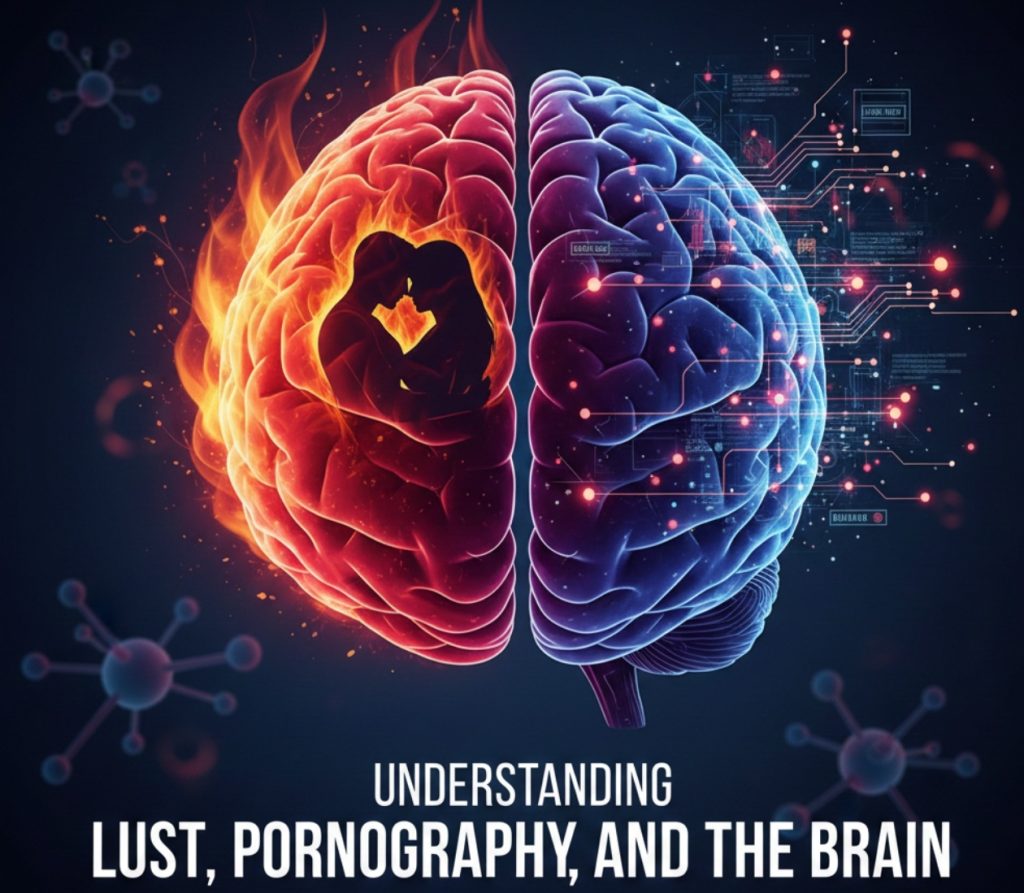
Today, we will focus on sexual hunger, and why lust is one of the most powerful forces in human behavior.
Lust is a natural feeling given to us by evolution.
It is both beneficial and dangerous—depending on how it is regulated.
When we lose control over this drive, it can slowly lead to self-destruction.
Lust and the Seven Deadly Sins
In classical philosophy and theology, lust is listed among the seven deadly sins:
- Gluttony
- Wrath
- Greed
- Pride
- Sloth
- Envy
- Lust
This does not mean sexual desire is evil. In fact, sexual desire is essential for human survival. Without it, reproduction would not exist, and humans would eventually become extinct.
The danger begins not with lust itself, but with the loss of control over it.
Lust From an Evolutionary and Psychological View
Sexual desire is not merely about physical pleasure. From an evolutionary perspective, it plays a role in pair bonding, emotional attachment, and reproduction.
Research suggests that males and females often experience lust differently:
- Females, on average, tend to associate sexual activity with emotional connection and attachment (though this is changing with cultural shifts).
- Males, on average, show a stronger separation between emotional attachment and sexual desire.
Healthy sexual intimacy requires both physical and mental presence.
Sex is not only an act of pleasure—it is a form of communication:
desire, affection, attachment, and bonding.
When sex is reduced to only pleasure, detached from emotional connection, that understanding is often shaped by pornography.
Pornography: The Modern Expression of Lust
To understand porn’s impact, we must first understand the brain.
The Brain’s Reward System
The brain learns through a reward-based system, primarily involving:
- Dopamine – released during anticipation and desire (“wanting”)
- Endorphins – released after the experience (“liking”)
Pornography causes intense dopamine release, creating a strong excitement response.
But dopamine alone is not the full story.
ΔFosB: The Addiction Switch
In cases of extreme or repeated reward, the brain releases a protein called ΔFosB (DeltaFosB).
ΔFosB is strongly associated with addiction.
It:
- Strengthens neural pathways
- Makes certain behaviors feel important and necessary
- Increases cravings and urges over time
This mechanism is involved in addiction to:
- Drugs
- Alcohol
- Smoking
- Gambling
- Pornography
Each repetition strengthens these neural pathways, making the behavior harder to stop—even when pleasure decreases.
Dopamine Adaptation and Escalation
Dopamine is adaptive, not unlimited.
The first exposure creates a strong response.
Over time, the brain adapts.
What once required one stimulus now requires more intense stimuli to achieve the same effect.
This is why:
- One cigarette becomes two
- One drink becomes many
- Soft porn becomes extreme porn
The same cycle repeats.
Porn Addiction Loop
- Initial exposure → dopamine spike
- Stress relief and pleasure
- Brain associates porn with reward
- Repetition increases
- ΔFosB strengthens neural pathways
- Behavior becomes a need
- Need turns into addiction
Eventually:
- Normal porn stops working
- Extreme content becomes necessary
- Real-life pleasures feel dull
- Motivation drops
- Emotional numbness increases
Even when pleasure disappears, the behavior continues.
Mirror Neurons and Behavioral Learning
Another critical factor is mirror neurons.
Mirror neurons help us:
- Learn by observation
- Develop empathy
- Understand emotions and actions of others
They do not distinguish between real life and video.
When a person repeatedly watches violent or unrealistic sexual acts:
- The brain records them as normal
- Expectations are reshaped
- Unrealistic beliefs about sex and consent develop
This can lead to:
- Repeating porn behaviors in real relationships
- Emotional disconnection
- Relationship conflict
- Erectile dysfunction
- Reduced empathy
Psychological Effects on Relationships
Porn can distort sexual expectations.
Some documented effects include:
- Reduced emotional bonding
- Difficulty being mentally present during sex
- Comparing partners to porn actors
- Performance anxiety
- Body image issues (especially in women)
In surveys, some porn addicts reported that during sex, they were mentally visualizing porn scenes instead of connecting with their partner.
Conclusion
Pornography is far more dangerous than it appears.
It does not only affect the mind—it reshapes the brain, behavior, emotions, and relationships.
Lust itself is natural and necessary.
But when hijacked by artificial stimulation, it can turn from a survival mechanism into a destructive force.
And the most dangerous part?
Often, we don’t realize the damage until it’s already done.