
What Is Electric Current? A Clear Scientific Explanation
Electric current is a fundamental concept in physics and electrical engineering. It plays a central role in how electrical systems operate, from simple household circuits to complex technological networks. In scientific terms, electric current describes the movement of electric charge through a material.
Although it is often described casually as “electricity flowing,” electric current is better understood as an organized physical process governed by electric fields and the behavior of charged particles.
The Scientific Meaning of Electric Current
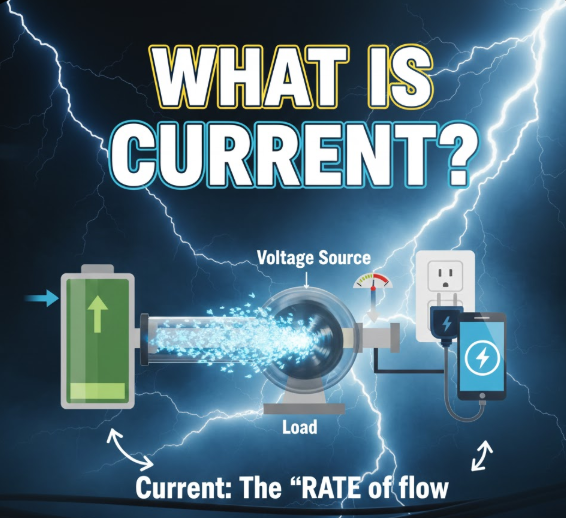
Electric current refers to how quickly electric charge passes through a point in a conductor. It does not describe the amount of charge present, but rather the rate at which charge moves.
The standard unit of electric current is the ampere. One ampere represents a steady flow of charge through a conductor over time.
What Actually Moves to Create Current?
In most everyday electrical systems, electric current is carried by electrons. In metallic materials, some electrons are not tightly bound to individual atoms. These free electrons are able to move throughout the metal’s structure.
Even when no current is present, electrons are constantly in motion due to thermal energy. However, this motion is random and evenly distributed, so it produces no net current. Electric current begins only when this motion becomes organized.
How Voltage Produces Electric Current
Electric current requires a driving force, and that force is voltage, also known as electric potential difference.
When voltage is applied across a conductor, it creates an electric field inside the material. This field applies a force to the free electrons, causing them to drift in a preferred direction. The combined drift of many electrons results in a measurable electric current.
Without voltage, electrons continue to move randomly, but no useful current flows.
Electron Drift and Speed of Electricity
A common misunderstanding is that electrons move rapidly through a wire. In reality, individual electrons drift very slowly. What moves quickly is the electric field that pushes them.
When a circuit is completed, the electric field spreads through the conductor almost instantly. This is why electrical devices respond immediately when switched on, even though the electrons themselves move only short distances.
Direction of Electric Current
By convention, electric current is defined as flowing from the positive terminal of a power source to the negative terminal. This direction was established before the discovery of electrons.
In metal wires, electrons actually move in the opposite direction. Despite this, the conventional current direction remains standard because it provides a consistent way to analyze electrical systems.
Electric Current and Resistance
As electrons move through a conductor, they collide with atoms, impurities, and defects in the material. These collisions oppose the motion of electrons and limit the amount of current that can flow. This opposition is known as electrical resistance.
Materials with low resistance allow current to flow easily, while materials with high resistance restrict it. Resistance is influenced by the type of material, its length, thickness, and temperature.
Heat Produced by Electric Current
When electrons collide with atoms inside a conductor, energy is transferred to the material in the form of heat. This process explains why wires warm up when current flows through them.
This heating effect is useful in devices such as electric heaters but can cause damage if current becomes too large.
Types of Electric Current
There are two main forms of electric current.
Direct current flows in a single, constant direction. It is produced by batteries and is commonly used in electronic devices.
Alternating current changes direction periodically. It is used in household and industrial power systems because it is efficient for transmitting energy over long distances.
Both forms are based on the same physical principles, differing only in how the electric field behaves over time.
Why Electric Current Is Important
Electric current is the mechanism that transfers energy from power sources to electrical devices. It enables lighting, heating, motion, communication, and computation.
Understanding electric current at a scientific level removes much of the mystery surrounding electricity and provides insight into how modern technology functions.
Final Thoughts
Electric current is not energy itself, nor is it voltage. It is the organized movement of electric charge caused by an electric field. From the microscopic behavior of electrons to the large-scale operation of power systems, electric current is the key process that makes electricity useful.
I