
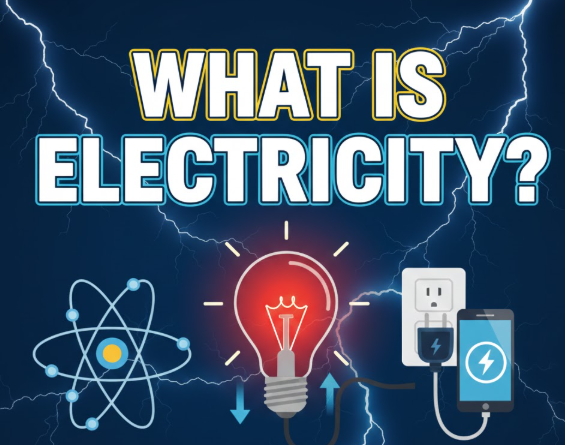
Electricity is basically the movement of tiny particles called electrons. Imagine water flowing through a pipe. The water itself is like electrons, the flow of water is current, the pressure pushing the water is voltage, and how narrow or rough the pipe is represents resistance. When the pressure is high and the pipe is open, water flows easily—same vibe with electricity.
What Is Electricity? A Scientific Explanation in Simple Terms
Electricity is one of the most important forces in modern technology, yet many people use it every day without fully understanding how it works. At its core, electricity is the flow of electric charge, usually carried by electrons moving through a conductive material such as metal.
This movement of charge allows us to power homes, run computers, and transmit information across the globe. Understanding how electricity works begins at the atomic level and builds up to the electrical systems we use every day.
Electric Charge: The Foundation of Electricity
Electricity originates from a fundamental property of matter known as electric charge. All atoms are made of three main subatomic particles:
- Protons, which carry a positive electric charge
- Electrons, which carry a negative electric charge
- Neutrons, which carry no electric charge
Electric charge is conserved in nature and is governed by the electromagnetic force—one of the four fundamental forces of physics. Opposite charges attract, while like charges repel.
Electrons play the central role in electrical systems because they are much lighter than protons and, in many materials, can move freely.
Free Electrons and Conductive Materials
In conductive materials such as copper and aluminum, atoms are arranged in a crystal lattice. Some of the outer electrons are not tightly bound to any single atom. These free electrons can move throughout the material, making electrical conduction possible.
In contrast, insulators like rubber or glass hold their electrons tightly, preventing charge from flowing easily. This difference between conductors and insulators is what allows electricity to be safely controlled in wires and circuits.
Voltage: What Causes Electric Current to Flow?
Electrons do not move in a wire unless a force acts on them. This force comes from a difference in electric potential, commonly known as voltage.
Voltage represents electrical potential energy per unit charge. When a voltage is applied across a conductor, it creates an electric field inside the material. This field pushes electrons, causing them to drift in a specific direction.
A useful analogy is water flowing downhill: the greater the height difference, the stronger the flow. Similarly, a higher voltage creates a stronger electric field and pushes electrons more forcefully.
Electric Current: The Flow of Charge
The movement of electric charge through a conductor is called electric current. Current measures how much charge passes through a point in a circuit per second and is measured in amperes (amps).
Even though electrons move quite slowly on average, electrical signals travel extremely fast because the electric field propagates through the conductor almost at the speed of light. This is why electrical devices respond almost instantly when switched on.
Electrical Resistance: Why Current Is Limited
As electrons move through a conductor, they constantly collide with atoms, impurities, and defects in the material. These collisions oppose the motion of electrons and limit how much current can flow. This opposition is known as electrical resistance, measured in ohms (Ω).
Resistance depends on several factors:
- The type of material
- The length of the conductor
- Its cross-sectional area
- Temperature
Longer and thinner wires have higher resistance, while thicker wires allow current to flow more easily.
Heat and Energy Loss in Electrical Circuits
When electrons collide with atoms inside a conductor, electrical energy is transferred to the atomic lattice as heat. This process is called Joule heating.
This explains why:
- Electrical wires can become warm
- Electric heaters work
- Excess current can damage electronic components
Electrical energy is not destroyed—it is converted into thermal energy in accordance with the laws of physics.
Ohm’s Law: The Key Relationship in Electricity
For many materials under stable conditions, the relationship between voltage, current, and resistance is described by Ohm’s Law:
Voltage = Current × Resistance
This fundamental law shows that:
- Increasing voltage increases current
- Increasing resistance reduces current
- Resistance controls how much current flows
Ohm’s Law is a cornerstone of electrical engineering and accurately describes the behavior of most metallic conductors.
When Ohm’s Law Does Not Apply
While Ohm’s Law works well for simple conductors, it does not apply universally. Components such as diodes, transistors, and LEDs show nonlinear behavior. Superconductors and plasma-based systems also follow different rules.
Even so, Ohm’s Law remains essential for understanding basic electrical circuits and everyday electrical devices.
Conclusion: Electricity Made Understandable
Electricity is not mysterious—it is a physical process rooted in the behavior of electric charge. Voltage creates an electric field, electrons respond by moving, resistance limits their motion, and energy is transferred through the system.
By understanding these basic principles, electricity becomes a logical and predictable phenomenon rather than an abstract concept.