
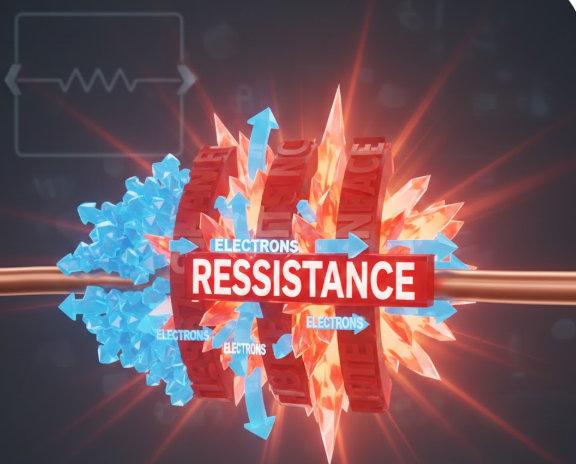
What Is Electrical Resistance? A Scientific Explanation
Electrical resistance is one of the fundamental concepts of electricity, alongside voltage and current. While voltage provides the driving force and current represents the flow of charge, resistance describes how much a material opposes that flow.
Every electrical system includes resistance. It plays a critical role in controlling current, protecting components, and converting electrical energy into useful forms such as heat and light.
The Scientific Meaning of Electrical Resistance
Electrical resistance is a physical property that describes how strongly a material resists the motion of electric charge. It arises from interactions between moving charge carriers and the atomic structure of the material.
Resistance is measured in a unit called the ohm. Materials with low resistance allow charge to flow easily, while materials with high resistance strongly limit current.
Why Resistance Exists at the Atomic Level
In conductive materials, electric current is carried by electrons. As these electrons move through a material, they do not travel freely in a straight line. Instead, they constantly collide with:
- Atoms in the crystal lattice
- Vibrations of those atoms caused by heat
- Impurities and structural defects
Each collision disrupts the motion of electrons and converts some electrical energy into thermal energy. This continual interference with electron motion is the physical origin of electrical resistance.
Resistance in Different Materials
Not all materials resist electric current in the same way.
Conductors, such as copper and aluminum, have low resistance because their atomic structure allows electrons to move relatively freely.
Insulators, such as rubber, glass, and plastic, have very high resistance because their electrons are tightly bound to atoms and cannot move easily.
Semiconductors, such as silicon, fall between conductors and insulators. Their resistance can be controlled, which makes them essential in modern electronics.
Factors That Affect Electrical Resistance
The resistance of an object depends on several physical factors.
Material type determines how easily electrons can move through the atomic structure.
Length affects resistance because electrons experience more collisions as they travel farther.
Thickness influences resistance because wider paths allow more electrons to flow at once.
Temperature plays a major role. In most conductors, resistance increases as temperature rises because atomic vibrations become stronger and interfere more with electron motion.
Resistance and the Control of Electric Current
Resistance is essential for controlling electric current in circuits. Without resistance, current would increase to dangerous levels, damaging wires and devices.
Resistors are intentionally designed components that provide precise amounts of resistance. They are used to limit current, divide voltage, and protect sensitive electronic parts.
Electrical Resistance and Heat
When current flows through a resistive material, electrical energy is converted into heat. This process is known as resistive heating.
This effect explains:
- Why power cables warm up
- How electric heaters and toasters work
- Why excessive current can cause fires
Resistance ensures that electrical energy is conserved by transforming it into other forms rather than disappearing.
Resistance and Energy Efficiency
While resistance is necessary, it also leads to energy loss in power systems. In long-distance transmission lines, resistance causes energy to be lost as heat.
To reduce these losses, engineers use thick conductors, high transmission voltages, and specialized materials with low resistance.
When Resistance Changes or Disappears
In some special materials at extremely low temperatures, electrical resistance can drop to zero. This phenomenon is called superconductivity.
In everyday materials, however, resistance is always present and must be carefully managed.
Why Electrical Resistance Matters
Electrical resistance shapes how circuits behave. It determines how much current flows, how much heat is produced, and how safely electrical systems operate.
From household wiring to advanced electronics, resistance is not a flaw—it is a necessary and useful property of matter.
Final Thoughts
Electrical resistance is the natural opposition to the motion of electric charge. It arises from atomic-scale interactions and plays a vital role in controlling electrical systems and converting energy into useful forms.
Understanding resistance completes the picture of how electricity works and reveals the balance between voltage, current, and material properties.