
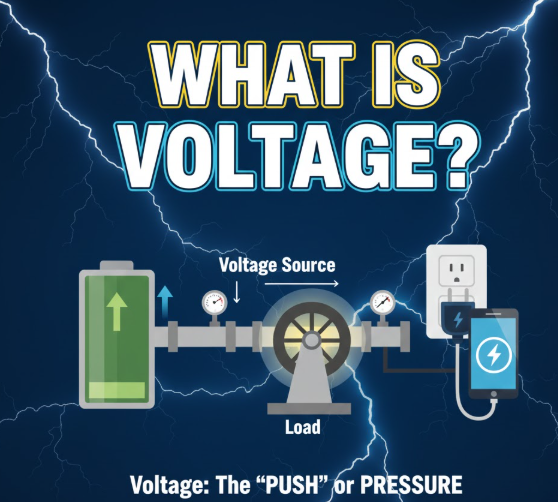
What Is Voltage? A Simple Scientific Explanation
Voltage is one of the most common terms in electricity, yet it is often misunderstood. We see it labeled on batteries, phone chargers, and power outlets—but what does voltage actually mean?
In simple terms, voltage is the force that pushes electric charge through a circuit. Without voltage, electricity cannot flow, no matter how good the conductor is. To truly understand voltage, we need to look at it from both a physical and scientific perspective.
Voltage and Electric Potential
Voltage is formally defined as electric potential difference. It represents the amount of electrical potential energy per unit charge between two points in an electric circuit.
In physics, voltage is expressed as:
Voltage = Energy ÷ Charge
This means voltage tells us how much energy each unit of electric charge carries. The higher the voltage, the more energy is available to move charges through a conductor.
Voltage is measured in volts (V), named after the scientist Alessandro Volta.
Why Voltage Is Necessary for Electricity
Electric charges, such as electrons, do not move in a wire unless a force acts on them. Voltage provides that force.
When a voltage is applied across a conductor:
- An electric field forms inside the material
- This electric field exerts a force on electrons
- Electrons begin to drift in response to that force
Without a voltage difference, electrons still move randomly due to thermal motion, but there is no net flow of current.
Voltage as Electrical “Pressure”
A common and useful analogy is to think of voltage as pressure in a water system.
- Voltage is like water pressure
- Current is like water flow
- Resistance is like the size of the pipe
High voltage means high electrical pressure, which can push more charge through a circuit. Low voltage means less push, resulting in weaker current if resistance remains the same.
This analogy helps explain why a 12-volt battery and a 230-volt wall outlet behave very differently, even if they power similar devices.
Sources of Voltage
Voltage is always created by a separation of electric charges. Common voltage sources include:
Batteries
Chemical reactions inside a battery separate positive and negative charges, creating a voltage between the terminals.
Generators
Electric generators use mechanical motion and magnetic fields to induce a voltage through electromagnetic induction.
Power Supplies
Electronic circuits convert and regulate voltage for safe use in devices like computers and phones.
In all cases, voltage exists because charges are kept apart, storing electrical potential energy.
Voltage and Electric Current
Voltage alone does not determine how much current flows. The amount of current depends on both voltage and resistance.
This relationship is described by Ohm’s Law:
Voltage = Current × Resistance
From this, we learn:
- Increasing voltage increases current (if resistance is constant)
- Increasing resistance reduces current (if voltage is constant)
Voltage is the driving force, but resistance controls the flow.
High Voltage vs Low Voltage
High voltage does not necessarily mean high current. A system can have:
- High voltage and low current, or
- Low voltage and high current
What matters for safety and power delivery is the combination of voltage and current, not voltage alone. This is why static electricity can reach thousands of volts but carries very little energy.
AC Voltage vs DC Voltage
There are two main types of voltage:
Direct Voltage (DC)
- Voltage remains constant in one direction
- Produced by batteries and solar panels
- Used in electronics
Alternating Voltage (AC)
- Voltage changes direction periodically
- Used in household power systems
- Efficient for long-distance transmission
Both forms rely on the same physical principles but behave differently in circuits.
Why Voltage Can Be Dangerous
High voltage creates strong electric fields that can force current through materials that normally resist electricity—including the human body. This is why high-voltage systems require insulation and safety precautions.
However, voltage itself is not harmful unless it causes a dangerous current to flow.
Conclusion: What Voltage Really Means
Voltage is the driving force behind all electrical systems. It represents stored electrical energy and creates the electric field that causes charges to move. Without voltage, there is no current, no power, and no electricity in action.
Understanding voltage makes electricity less mysterious and helps explain how electrical devices operate safely and efficiently.